Natural Mapping in Games: Feeling Present and Staying in Control
Natural mapping in games can change how control feels. Explore a 2013 racing study separating spatial presence, reported control and race results.
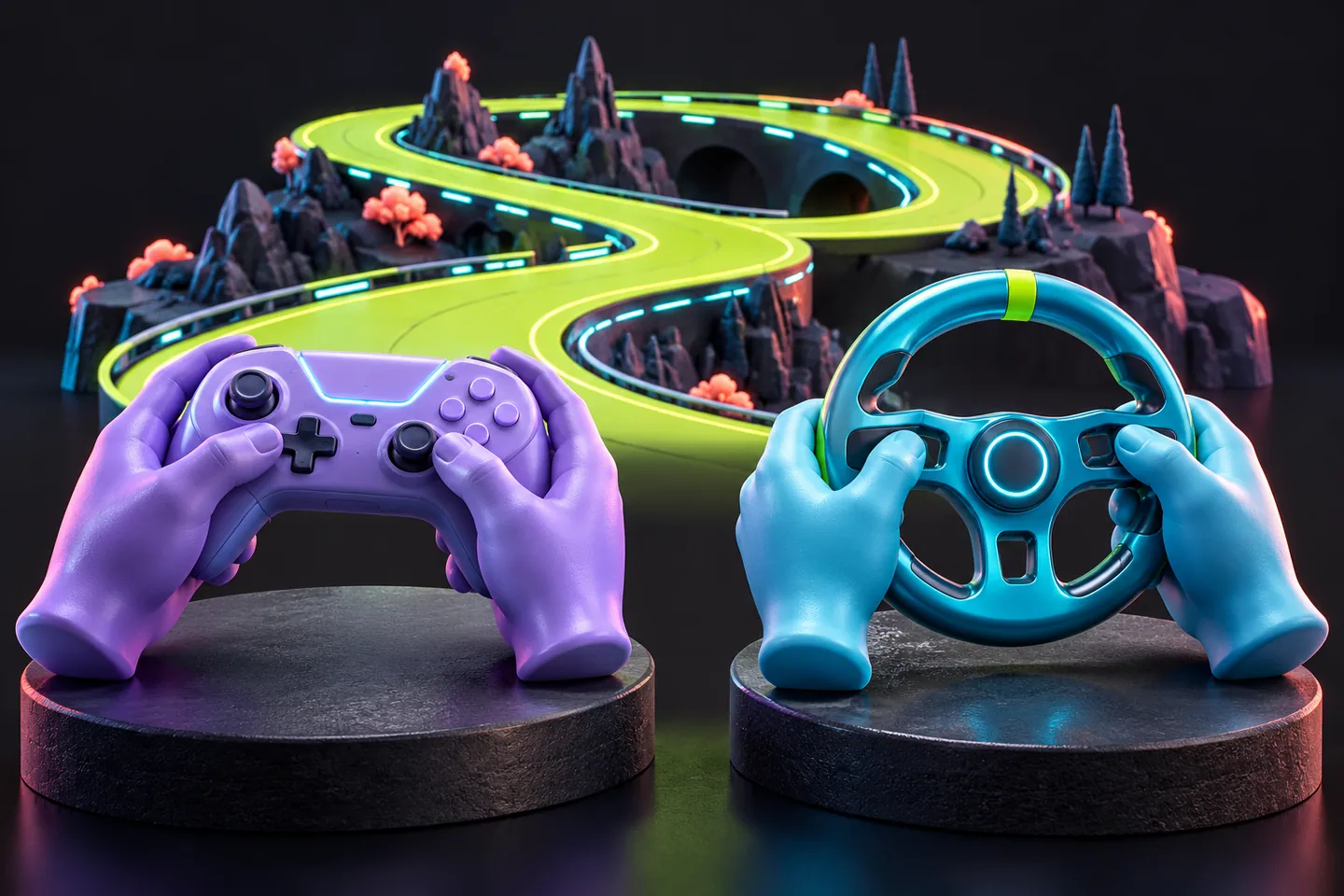
A recognizable gesture is only one property of an input
Natural mapping in games describes the correspondence between an input and the activity it represents. Turning a handheld ring to steer resembles the depicted action more closely than pushing a small stick sideways. That resemblance gives a comparison a starting point; it does not settle whether the player can make the correction they intend.
Consider two proposed questions about a controller: does operating it help someone feel located inside the game world, and can they direct a vehicle accurately? Those questions can produce different answers. Calling an interface realistic, intuitive or better without naming the outcome conceals the distinction that makes the research interesting.
A 2013 experiment compared two ways to race together
Vanden Abeele and colleagues analyzed 78 participants playing Mario Kart Wii in pairs. Each used a classic controller and a tilt-based Wii steering wheel, with order counterbalanced. Questionnaires followed each condition, while race finishing positions supplied a separate performance measure. Two participants’ records had been lost to a storage error.
This is older research presented at FDG 2013. Having people encounter both devices supports a comparison within the same participants. Counterbalancing addresses which device comes first; it does not give everyone the same history of practice with the devices or remove every possible influence from a competitive race.
Presence, control and race results did not move together
The wheel received higher naturalness and spatial-presence ratings, but lower perceived control and competence, alongside worse finishing positions. Immersion, positive affect and social behavioral engagement showed no significant controller effect. Frustration was higher with the classic controller.
The result cannot be compressed into a single upgrade score. A report about feeling inside the depicted space differs from a report about commanding the vehicle, and a finishing position differs from both. The null comparisons belong alongside the detected differences: the evidence does not show every experience improving with the more physically literal input.
An invented crane makes the attribution problem concrete
Imagine an original crane game with a hook that must stop inside a marked zone. One prototype turns the crane when the player rotates a handheld ring; another responds to a thumbstick. Suppose a tester likes the ring’s theatrical action but repeatedly overshoots the zone. That fictional account contains a preference and a control problem, without requiring either to cancel the other.
Before explaining the overshoot, inspect how the prototypes translate input into motion. Do they share a maximum turning speed? Does releasing the control stop the hook immediately? A comparison that changes those rules together with the device cannot attribute the entire result to resemblance alone. These are proposed checks, not additional findings from the racing study.
Keep the hardware and measurement boundaries visible
The study used campus recruitment and one game. The authors removed several questionnaire subscales for low reliability and left device precision versus accumulated gamepad experience unresolved as explanations.
A tilt wheel should not silently stand for every piece of simulation hardware. Similarly, a race placement does not identify the precise movement that caused a loss. Familiarity, software response and the surrounding task deserve separate investigation. Failure to detect a difference does not prove that players had identical experiences with the two devices.
Make the comparison answer a stated design question
For the fictional crane, choose a concrete target before testing: stopping accuracy, reported control or the feeling of operating the machine. Record the device and its response rules beside that outcome. If one version produces a preferred atmosphere and another supports tighter corrections, preserve both observations before deciding which matters for the intended encounter.
These links provide the paper and its university catalogue entry; neither introduces a second experiment. Their contribution to motion controls research concerns a specific encounter, without supplying a universal ranking of input devices. A useful next comparison would specify the action, the player’s experience with it and the outcome that would justify changing the design.
Keep exploring
Sources & further reading
- Vanden Abeele et al. (2013): More Naturalness, Less Control — full original paper, KU Leuven copy ↗
- KU Leuven Lirias: original FDG 2013 publication record and full-text link ↗
Have a correction? Tell our editorial team.