Player Uncertainty: What a Game Experience Scale Measures
Explore player uncertainty through an original game-experience study, separating reported understanding, unpredictable outcomes and measurement limits.
Name the unknown before judging the moment
Player uncertainty can begin with a simple question: what, exactly, remains unknown? Before describing an encounter as confusing, ask whether the player can explain the available actions, predict their consequences or identify what information is missing. A comment such as “I have no idea” leaves those possibilities unresolved.
For an original playtest, invite the player to complete that sentence: “I have no idea whether…” Their answer gives a concrete event to inspect. It does not automatically tell you whether the encounter was enjoyable, too difficult or worth changing. Those judgments require questions of their own.
The scale separates several reported experiences
Power and colleagues’ paper, first published online in 2018, developed the Player Uncertainty in Games Scale (PUGS) from 674 valid play-session questionnaires. Its final 24 items cover decision-making, taking action, problem solving, exploration and external uncertainty.
A questionnaire organizes answers to particular statements. Reading its categories as five permanent kinds of player would change the subject. Someone can understand an action in one encounter and feel unsure in the next. For interpretation, attach a response to the session and question that produced it, rather than assigning an identity.
One experiment changed when play stopped
In a separate experiment, 40 University of York students were randomly assigned three or five minutes with the same Contraption Maker puzzle. They read controls information beforehand and did not know their time limit. Decision-making and problem-solving uncertainty were significantly higher after three minutes. Taking action, exploration and external uncertainty showed no significant differences.
The comparison concerns ratings after different amounts of play. It does not establish that adding two minutes improves every puzzle, or that longer play necessarily creates pleasure. Keeping the unchanged comparisons visible also prevents a selective account in which every aspect of the experience supposedly moved together.
Try two versions of a fictional mechanism
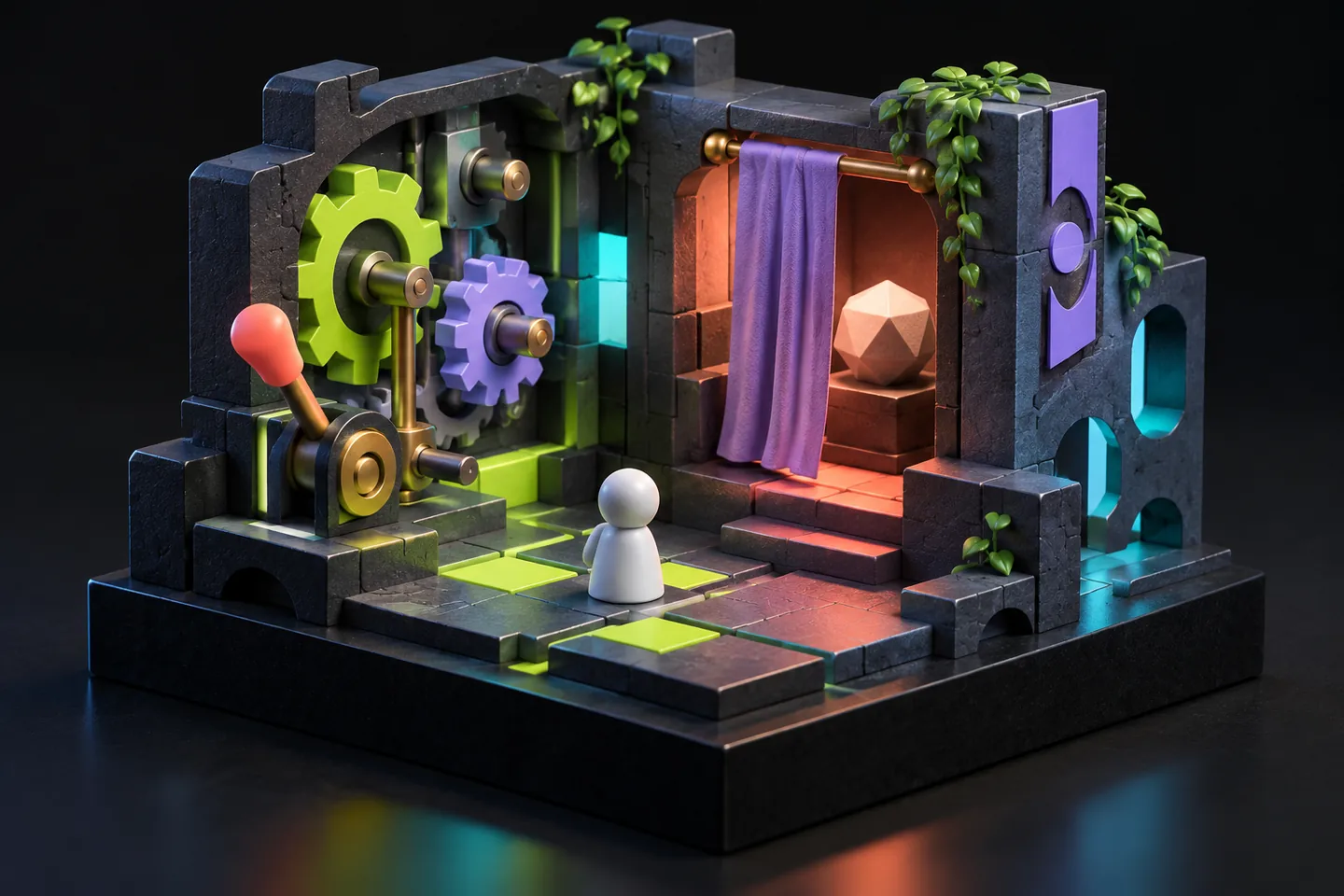
Imagine an invented clockwork room with three levers and a sealed compartment. In version A, every lever works predictably, but the player cannot explain which combination opens the compartment. In version B, the player understands the combination, but the lock deliberately draws a concealed result after each attempt.
Both players might describe an uncertain outcome. Their explanations would point to different questions: what rule is being inferred, and what result remains unavailable even after the rule is understood? These fictional versions illustrate an interpretation problem, not an additional experiment or evidence that either mechanism produces a preferred feeling.
Preserve the measurement limits
The development sample predominantly comprised male, frequent players. The experiment used one puzzle and a student sample; the problem-solving subscale’s reported reliability was 0.58.
A scale’s consistency matters when comparing responses, especially when a proposed difference is small. A nonsignificant comparison also leaves uncertainty about differences the study could not detect. It should not become a promise that two experiences are identical. Evidence from a narrow encounter cannot settle how an unfamiliar audience will interpret an entire campaign.
Player uncertainty needs a specified question
For a proposed evaluation, record the encounter, the information available and the exact question asked. Keep a report about understanding separate from a completion count or a preference rating. If you change a mechanism, state which experience you expect that change to affect before seeing the responses.
Use this as a planning exercise, not a validated scoring shortcut. The full paper and institutional record below identify the same older research, not independent replications. Their role here is to make the measurement question inspectable: which unknown did the player report, and what observation could clarify its meaning?
Keep exploring
Sources & further reading
- Power et al. (online 2018): Lost at the Edge of Uncertainty — full published paper ↗
- City St George’s, University of London: original study record and accepted manuscript ↗
Have a correction? Tell our editorial team.