Game Audio Cues: What Changes When Sound Is Muted
Explore game audio cues through a 2008 qualitative study of muted play, including lost information, reduced distraction and important limits.
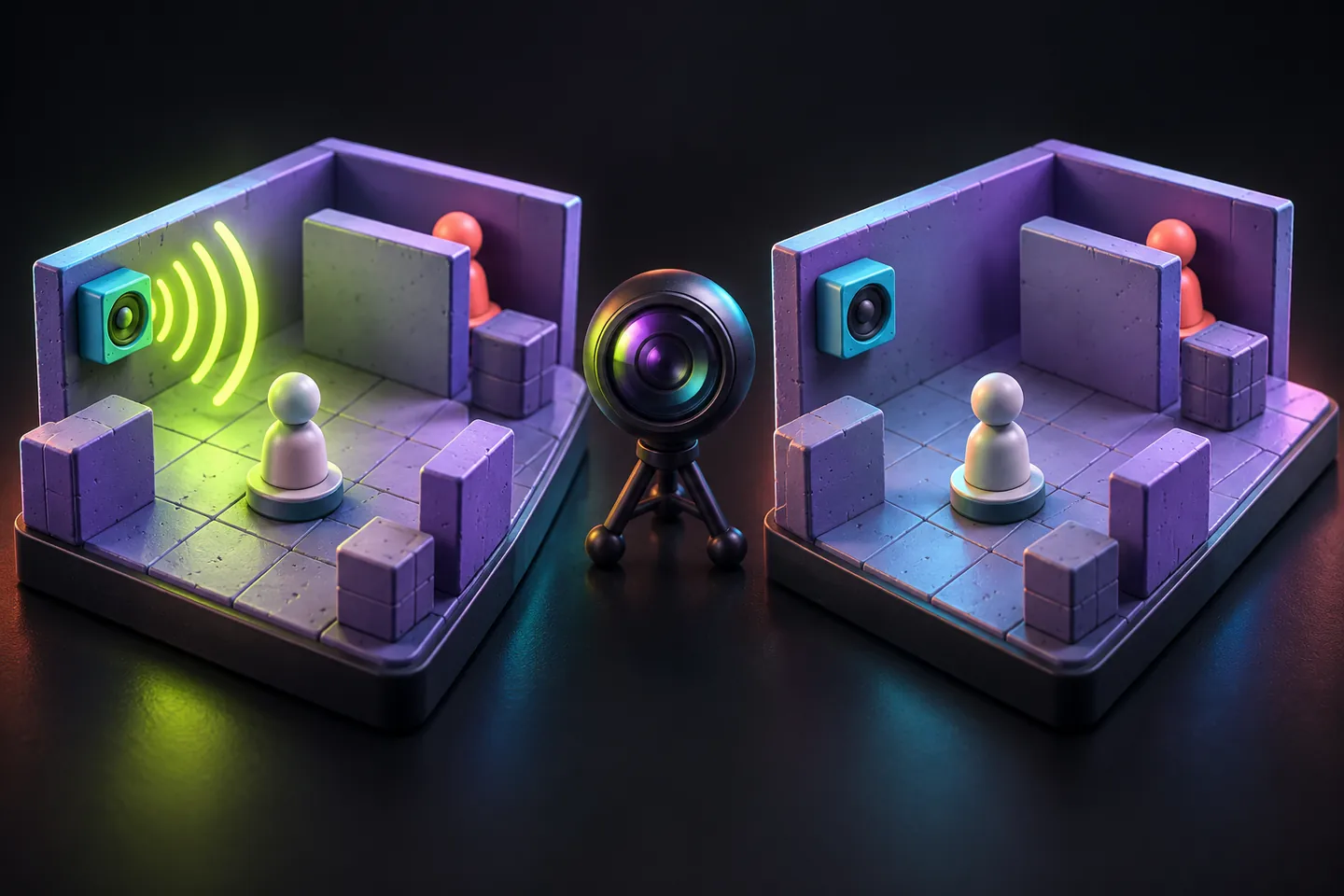
Ask what the sound communicates
Game audio cues deserve a specific question: what does this sound communicate, and when can the player use that message? Before treating audio as one adjustable layer, separate confirmation of an action, notice of a changing situation and the atmosphere surrounding both.
Imagine a fictional workshop game. A short chime might mean the machine accepted a button press, or it might mean the finished part is ready to collect. Those meanings support different decisions. Removing the chime is easier to assess once its job has been named.
A qualitative comparison published in 2008
Jørgensen’s 2008 chapter reported thirteen qualitative play-observation studies involving experienced Warcraft III or Hitman Contracts players. They played with sound for about 15–20 minutes, then without it for another 10–15. Recorded play supported an immediate follow-up conversation about actions and audio. Participants had not been warned that the sound would disappear.
A recording gives an interview a concrete reference point: which command was issued, what happened next and what the player noticed. It can help locate the event behind a comment. The comment still describes that person’s interpretation of the encounter.
Notice information about unfinished and unseen work
Accounts described missing off-screen warnings and completion messages, and uncertainty about whether commands had registered. These are qualitative observations, not a measured average performance penalty.
Return to the invented workshop. The player starts a machine, then walks elsewhere to sort materials. A completion signal could provide a reason to return without keeping the machine in view. A visible progress meter could carry similar information, yet require checking that location. In a proposed comparison, record when the process finishes, when the player notices and what they were attending to. These observations would distinguish availability of information from actually receiving it.
Retain the contrasting accounts
Some participants also described less distraction and more systematic play without sound. The chapter therefore contains contrasting accounts, rather than a single response shared across situations.
A notification can be informative while arriving at an inconvenient moment. In our fictional workshop, a bell for every completed small part might repeatedly draw attention away from a time-sensitive assembly step. That possibility suggests a more precise design question: which events warrant an immediate interruption, and which can wait in a visible queue? This fictional workshop supplies questions to investigate in a future comparison.
Keep the sequence and evidence type visible
The audible segment always came first, and the chapter provides no randomized order comparison or statistical effect-size estimate.
That structure combines removing audio with advancing through a session and encountering an unexpected change. It cannot isolate every contribution to a reported difficulty. Familiarity also deserves attention: somebody who already knows a command’s response may infer what happened from a different cue. A newcomer may have a different uncertainty. Comparing such players would require evidence about their respective experiences; an explanation that sounds plausible cannot supply those observations.
Make a proposed inventory of cues
For an original prototype, write down each cue’s trigger, message, timing and available alternative. Then ask what decision depends on receiving it. A confirmation signal, an urgent warning and an atmospheric sound need not share the same evaluation. Use this as a planning exercise; the proposed checks have not been tested here.
The archive and publisher links identify the same 2008 chapter. When discussing a muted play session, describe which message became harder to notice and which interruption disappeared. That account gives another reader something specific to examine, without turning a short qualitative comparison into a universal volume setting.
Keep exploring
Sources & further reading
- Kristine Jørgensen (2008): Left in the Dark — original chapter and public download in the national archive ↗
- Routledge: From Pac-Man to Pop Music, original copyright and chapter contents ↗
Have a correction? Tell our editorial team.