Kakuro Combinations: Cross Sums Without Guessing
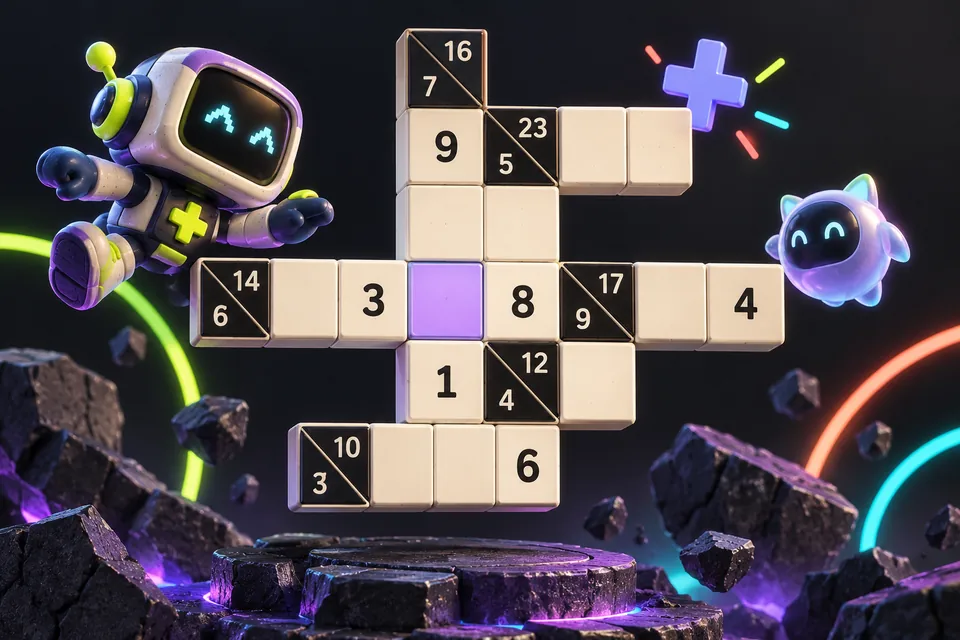
Use Kakuro combinations to narrow a run, check its crossing and avoid repeated digits. Work through original examples and a complete mini Kakuro grid.
Read the sum and the run length together
Kakuro combinations are sets of different digits that reach a particular sum in a particular number of cells. Knowing only the target is not enough: 7 across two cells has different possibilities from 7 across three. Count the cells before listing digits, then keep the sum beside that count.
Nikoli's standard rules use digits 1–9, exclude zero and forbid repeating a digit within a consecutive run. Horizontal and vertical clues constrain the same crossing cell. The restriction belongs to each run; it is not a rule that every digit may appear only once across an entire conventional Kakuro puzzle.
A combination does not settle the order
For an original three-cell run totaling 7, the only allowed set is {1,2,4}. The smallest three different digits already total 6, and the next possible total gives that set. But 1,2,4 and 4,1,2 are different placements of the same combination. Keep those positions unresolved until another clue distinguishes them.
For three cells totaling 8, the possible sets are {1,2,5} and {1,3,4}. A two-cell sum of 17 permits only {8,9}. These small lists make a useful handwritten reference. A unique set means every listed digit appears somewhere in the run; it does not license filling the cells from left to right.
Use the crossing to choose one digit
Suppose the three-cell 7-run crosses a two-cell 4-run. The first permits {1,2,4}; the second permits {1,3}. The crossing must satisfy both, so it is 1. The other cell in the 4-run becomes 3. The remaining 7-run cells contain 2 and 4, with their order still open.
This is a local deduction, not a complete puzzle. Write the reason beside the placement: the two candidate sets share only 1. If a different crossing still allows two values, preserve both. Choosing a convenient order would turn an arithmetic fact about the whole run into an unsupported claim about one square.
Subtraction must remember the used digits
Consider a three-cell 12-run with a confirmed 4. The two empty cells must total 8. Their possible sets are {1,7}, {2,6} and {3,5}. The apparent answer {4,4} is illegal twice over: it repeats within the empty pair and repeats the 4 already placed in the run.
Keep a short record of the remaining total, number of spaces and used digits. After a crossing fixes another value, update all three. As a quick error check, three distinct digits cannot total less than 6 or more than 24. Bounds can reject an impossible assumption before you enumerate every combination.
Solve an original mini Kakuro example
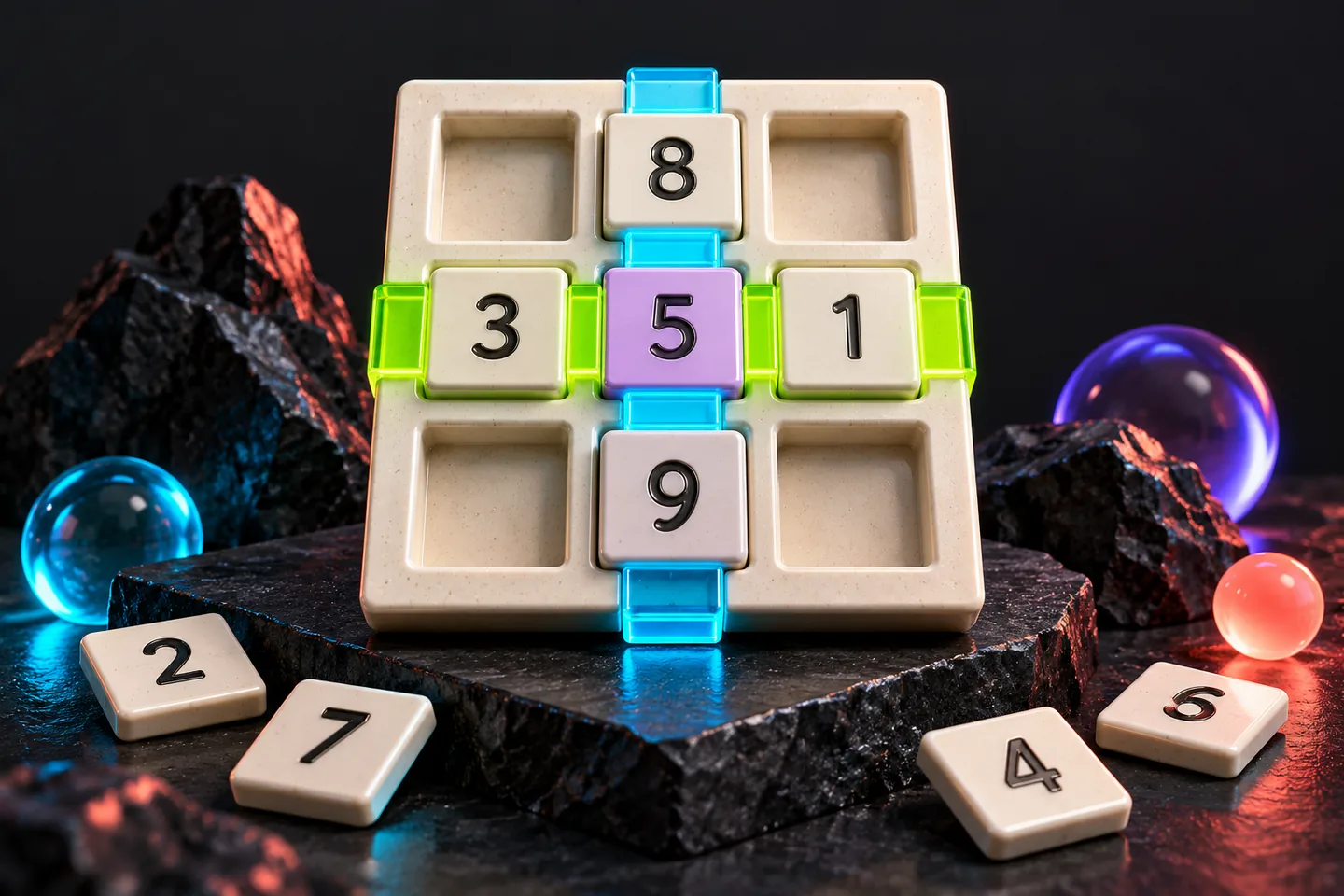
ProjectGAMR's version checked on October 29, 2026 is a 3×3 starter: every row and column is one run, with five fixed digits. Here is an invented training board, where slashes separate rows and underscores are empty: “1 2 _ / 4 _ 6 / _ 8 _”. Its row targets are 6,15,24; its column targets are 12,15,18.
Row one gives R1C3 = 6−1−2 = 3. Row two gives R2C2 = 15−4−6 = 5. Column one then gives R3C1 = 12−1−4 = 7. Row three gives R3C3 = 24−7−8 = 9. The finished rows are 1 2 3 / 4 5 6 / 7 8 9. Check all three columns and the no-repeat condition too.
Transfer the method to your own board
Your generated board will usually differ from that exercise. Type one digit into each editable cell, keeping combination notes separately; the interface does not provide pencil-mark sets. Check sums validates the filled grid. To revise an entry, clear its field and enter another digit. New game creates another starter rather than preserving your unfinished one.
Begin with a run whose missing sum and spaces leave few possibilities. Compare its crossings, place only forced values and update the remaining totals. The small starter can often be completed by subtraction. Larger conventional boards need more work to establish order, even after the right digit sets have been found.
Keep exploring
Sources & further reading
Have a correction? Tell our editorial team.