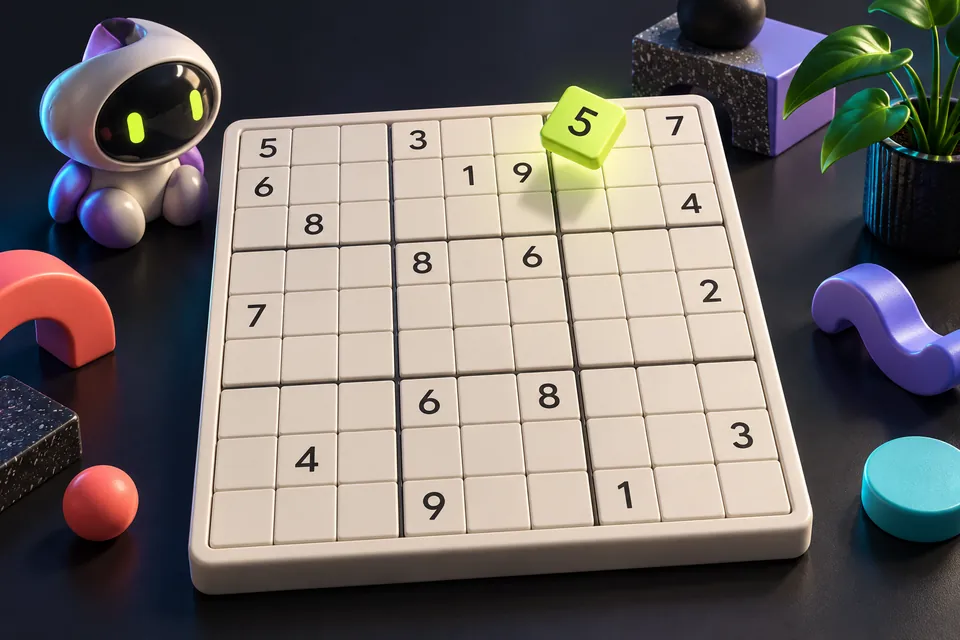
Solve Beginner Sudoku Without Guessing
Use candidate lists, naked singles and hidden singles to solve beginner Sudoku logically. Work through a small, original exercise without guessing.
Use constraints, not arithmetic tricks
In standard Sudoku, every row, column and three-by-three box contains the digits one through nine exactly once. The digits are labels: you do not need to add them, multiply them or discover a numerical sequence. Nikoli’s rules below are the reference for the basic puzzle.
A candidate is a digit that has not yet been ruled out for a particular empty cell. It is a possibility, not a commitment. Start by comparing a cell’s row, column and box. A value already present in any one of those units cannot go into that cell. Keep pencil marks separate from placed answers.
Build a candidate intersection
Here is an original nearly completed training grid. Each slash starts the next row, and a dot marks an empty cell: ..3456789 / .56789123 / 78.123456 / 234.67891 / 5678.1234 / 89123.567 / 345678.12 / 6789123.5 / 91234567.
Look at row one, column one, written r1c1. Its row lacks one and two. Its column lacks one and four. A digit must satisfy both conditions, leaving only one. Its top-left box also permits one. Enter 1 at r1c1 because every other choice breaks an existing constraint, not because one happens to look plausible.
Follow the chain of singles
After placing r1c1 = 1, row one has only one empty cell, r1c2, so it must be 2. Row two is missing 4 at c1. Row three is missing 9 at c3. Rows four through nine each have a single missing digit: 5, 9, 4, 9, 4 and 8 respectively.
Those placements complete the exercise. Check every column and box, rather than trusting the final visual pattern. This training grid deliberately uses easy deductions so you can rehearse the method. It does not demonstrate that every Sudoku puzzle can be finished using singles alone.
Spot a hidden single
A naked single is a cell with one remaining candidate. A hidden single is a digit with only one possible cell in a unit, even when that cell has other candidates. Switch your viewpoint from “what fits here?” to “where can this digit go in this row?”
For a separate candidate-list exercise, imagine a row missing 2, 5 and 7. Its three empty cells have candidates {2,5}, {2,5,7} and {2,5}. Only the middle cell can hold 7, so place 7 there. The other two cells remain unresolved; do not choose between 2 and 5 without another constraint.
Update only what changed
After entering a digit, remove it from candidate lists in the same row, column and box. Those are its peers. Look for a newly created single among those cells before scanning unrelated parts of the board. This turns a large search into a smaller chain of consequences.
If no single appears, inspect every unit for hidden singles. A contradiction, such as a cell with no candidates, suggests an earlier error or an incomplete candidate list. Recheck the assumptions before adding more entries. A fast guess can hide the original mistake and make the later board much harder to diagnose.
Build a repeatable solving loop
Use this loop: scan for nearly full units, list candidates carefully, place a naked or hidden single, update its peers, then scan again. When you stall, choose a different box or a different digit to follow. Taking a brief pause can be more productive than repeatedly staring at the same three cells.
For a practice goal, explain each placement in one sentence: “This is the only place for eight in column six.” If you cannot state the reason, keep it as a candidate. Harder puzzles may need pairs, intersections or more advanced logic. For now, finish beginner grids accurately before worrying about speed.
Sources & further reading
Have a correction? Tell our editorial team.