Futoshiki Strategy: Turn Inequalities Into Candidate Bounds
Use this Futoshiki strategy to narrow candidates with inequality chains, combine row and column clues, and check original examples on a 4×4 board.

Keep the board's three conditions together
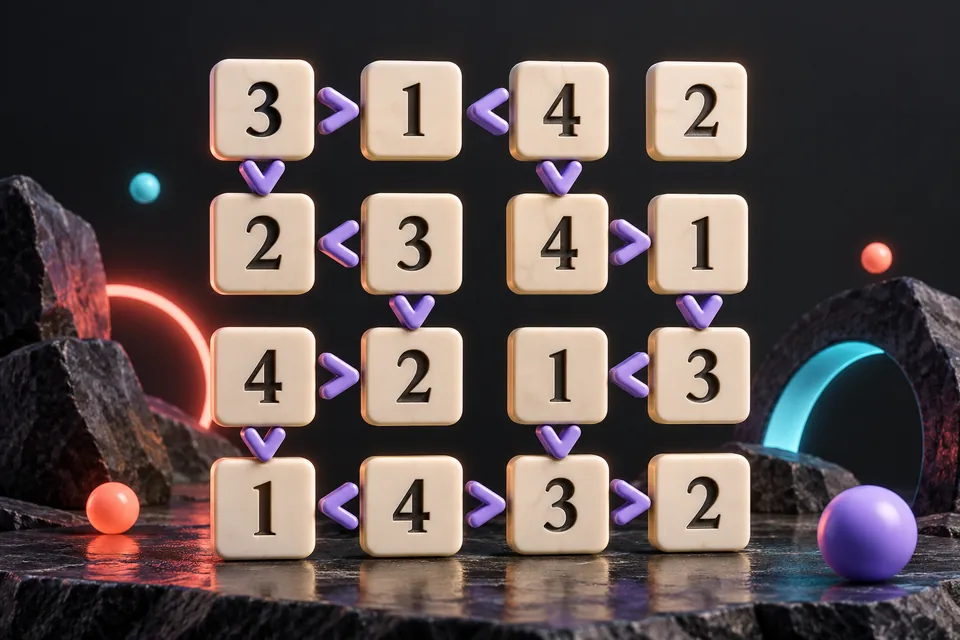
A useful Futoshiki strategy turns each inequality into a limit on possible digits. On ProjectGAMR's 4×4 board, every row and column must contain 1, 2, 3 and 4 exactly once. Every listed less-than relation must also be true. There is no additional box rule to check.
The coordinate R1C2 means row one, column two. The relation R1C2 < R1C3 says the first named cell is smaller, even when you read the clue beneath the board rather than between cells. Simon Tatham's Unequal manual and Puzzler's instructions provide the general puzzle context; the controls here follow this site's version.
One sign removes the impossible extremes
For two cells A < B, A cannot be 4: no allowed digit would remain above it. B cannot be 1 for the corresponding reason. Before considering other clues, A has candidates {1,2,3} and B has {2,3,4}. These are bounds, not final answers.
Do not replace smaller with one smaller. The pair A = 1, B = 4 satisfies the sign just as 2 and 3 do. Likewise, A > B reverses which cell needs the larger value; it does not ask you to subtract their values or place consecutive digits.
Count the steps in an increasing chain
Now compose a three-cell row fragment A < B < C. Two larger distinct digits must fit above A, so A is at most 2. Two smaller digits must fit below C, so C is at least 3. The bounds are A in {1,2}, B in {2,3}, C in {3,4}.
A four-cell row with A < B < C < D is stronger still. Four strictly increasing values drawn from 1–4 can only be 1, 2, 3, 4. These are original worked fragments, not promised starting layouts or a board-import feature. A generated puzzle may offer shorter chains that need other clues.
Combine ordering with the missing digits
Consider the composed row 2, blank, blank, 4, with R1C2 < R1C3. The two missing digits are 1 and 3. Their order is forced: R1C2 = 1 and R1C3 = 3. The inequality supplies the ordering; the row supplies the available values.
After placing either value, revisit its column. That placement can remove a candidate elsewhere without touching another sign. Conversely, a column can shorten a chain's candidate list first. Keep combining the restrictions rather than treating inequality clues and row-column elimination as separate puzzles.
A contradiction is a reason to review
If a smaller cell has been assigned 3 and its larger neighbor can only be 2, those entries cannot both survive. Recheck the givens, the clue's coordinate order and any earlier placement. Do not reverse the printed relation to rescue the entries.
A candidate list with no remaining digit is another warning. Writing possibilities on paper can help track why each was removed. This version accepts one entered number per editable cell; paper notes are a suggested aid, rather than a built-in pencil-mark mode or an automatic hint.
Validate the completed board against every rule
Work from fixed digits, trim impossible extremes, extend any useful chain and cross-check rows with columns. Enter whole digits from 1 to 4 in blank cells. Given digits stay fixed. Choose Check puzzle when you want the game to validate your entries; a full-looking grid alone is insufficient.
Before submitting, read each row, each column and all six listed relations. A Latin square can still violate an inequality. New game generates another checked puzzle. The goal of this routine is an explainable placement: name the sign, chain or missing-digit restriction that forces it before treating a possibility as an answer.
Keep exploring
Sources & further reading
- Simon Tatham's Portable Puzzle Collection: Unequal rules and variants ↗
- Puzzler: Futoshiki instructions and inequality-chain examples ↗
Have a correction? Tell our editorial team.