Calcudoku Cages: When Repeated Numbers Are Allowed
Solve Calcudoku cages by checking arithmetic and cell positions together. Work through a 4×4 example where repeated digits can be valid in one cage.
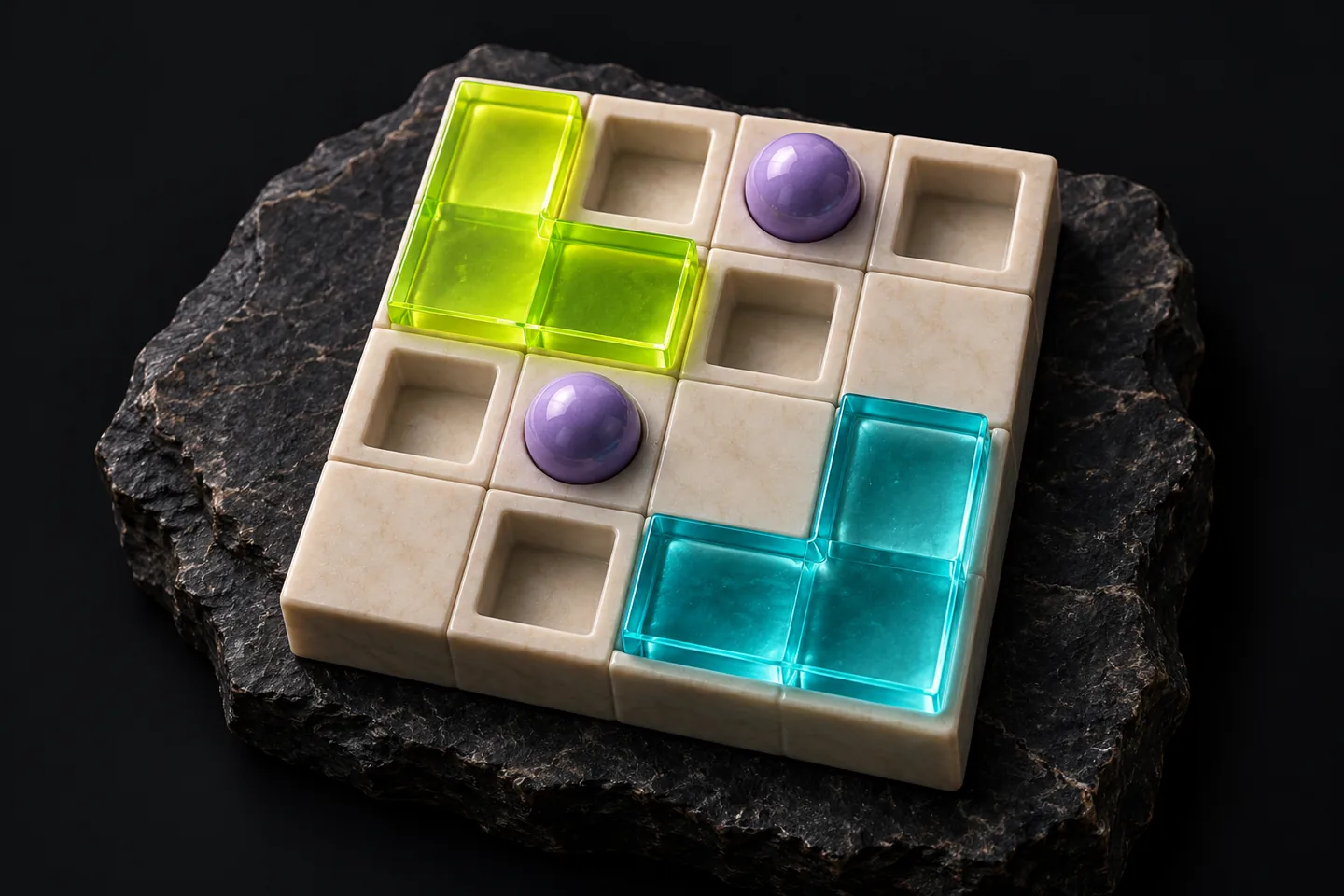
Read the cage and the lines together
Calcudoku cages combine an arithmetic instruction with a placement problem. For this guide, use a four-by-four grid containing 1, 2, 3 and 4 once in each row and column. Conceptis permits repeated digits inside a block; that permission still has to respect the row and column rule.
A cage total does not tell you which digit belongs in which square. Write a possibility as a placement, such as top cell 2 and bottom cell 3, rather than treating an unordered pair as a finished deduction. The examples below are original exercises, not copied publisher puzzles.
Turn a product into two possible placements
Imagine a two-cell vertical cage at R2C1 and R3C1 marked 6×. Within 1–4, its entries must be 2 and 3. The pair 1 and 6 is outside this grid's range. There are two placements to consider: 2 above 3, or 3 above 2.
Now suppose R2C2 already contains 3. R2C1 cannot also contain 3, so place 2 there and 3 at R3C1. This uses an existing row entry to orient a product pair. Without that extra information, multiplying correctly would leave both placements available.
A repeated digit can fit an L-shaped cage
Consider a different cage containing R1C3, R1C4 and R2C4 with target 8+. In that order, 2, 4, 2 reaches eight. The two 2s occupy different rows and columns, so the repetition itself is allowed. A diagonal is not another line that must contain four different digits.
Rearrange those same entries to 4, 2, 2. The arithmetic still works, but the two 2s now share column 4. Reject that placement. These are two arrangements of the same multiset with different validity; a list of possible sums that ignores cage shape cannot distinguish them.
Use a placed value to finish the cage
Return to the 8+ L-shaped cage and suppose R1C3 is confirmed as 2. Its other two cells must sum to six. Within 1–4, the remaining pair is 2 and 4 or 3 and 3. Because R1C4 and R2C4 share a column, 3 and 3 is unavailable.
The remaining 2 cannot go at R1C4, which shares a row with the confirmed 2. Therefore R1C4 is 4 and R2C4 is 2. The cage has a repeated digit precisely because its repeated entries occupy the separated cells. This deduction is local; it does not establish a unique solution for an otherwise unspecified grid.
Apply the method to this site's starter
ProjectGAMR's Calcudoku starter, checked October 31, 2026, uses a 4×4 grid, addition cages, one multiplication cage and a single-cell cage. Letters in the cells match the cage legend below the board. Read the letter's target and operation before calculating; this starter does not ask you to infer subtraction or division.
A single-cell label such as G: 3 means that cell is 3. Given digits stay fixed; enter answers in the remaining number fields. Use Check puzzle after combining cage arithmetic with every row and column. A correct isolated cage can coexist with a wrong neighboring entry. The composed L-shaped exercise is not a promised generated starting layout.
Keep candidates specific enough to reject
For each unresolved cage, note its target, operation, cell coordinates and surviving placements. Cross out an arrangement when it repeats a digit in a line or conflicts with a confirmed entry. Preserve another arrangement until an actual constraint removes it. Counting possibilities is useful only when they refer to identifiable cells.
Use New game for another starter after finishing. The practical habit is to check both questions together: does this arrangement meet the arithmetic target, and can these particular squares hold those digits? Repeated values are neither automatically wrong nor automatically safe; their positions decide which conclusion follows.
Keep exploring
Sources & further reading
- Conceptis: CalcuDoku rules and repeated numbers within blocks ↗
- KenKen Customer Care: row, column, cage and single-cell rules ↗
Have a correction? Tell our editorial team.