Video Game Subtitles and the Effect of Voice Language
Video game subtitles can carry more of the dialogue when the voices are unfamiliar. See how a 2026 study measured where players looked and for how long.
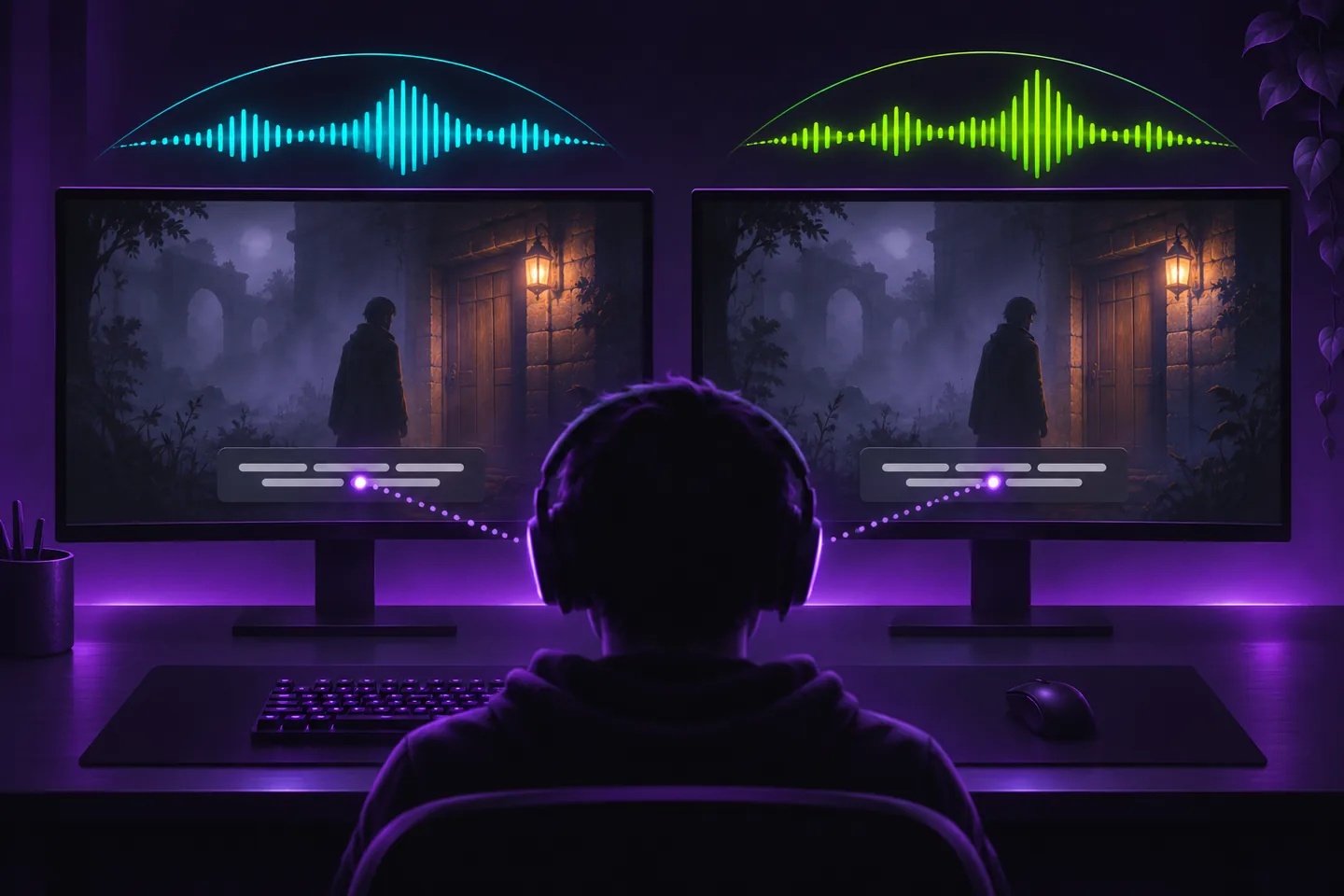
One line can guide a decision
Video game subtitles can tell you what to do while your eyes are busy with the scene. Imagine a fictional station where a voice tells you to use the west lift after the lights dim. As the line appears, the lights change and two lift doors come into view.
If you catch the instruction in the voice, you can look at the doors while listening. If you depend on the text, you might glance back to confirm which lift it names. The two players could take the same lift while looking at the screen in different ways.
The game text stayed in English
Lan, Kruger and Richardson’s 2026 study analyzed 98 native English speakers playing the opening chapter of Detroit: Become Human. The researchers randomly assigned voice language. Both groups saw English text. One heard English and the other heard Polish, which participants said they did not understand.
Eye tracking let the researchers compare behavior while people played. In the fictional station, changing the voice language would leave the lift labels intact. It would change whether players could get the instruction by listening while keeping their eyes on the doors.
Players spent more time looking at the lines
The Polish-audio group spent more of each subtitle’s display time looking at it and a greater share of their eye movements went backward. The difference in how often players skipped entire subtitles did not reach statistical significance.
A backward movement could land on “west” while someone checks which lift to use. A longer look could also come from revisiting when to step inside. Those actions would register as attention to the text. To know which detail was understood, you would need a separate observation.
The first look and a return look tell different stories
The Polish-audio group skipped fewer words and spent longer looking at individual words in total. The groups’ first-pass gaze duration on words did not differ significantly.
In the station example, you might glance at “west,” look at the lights and return to “west” before moving. The second glance adds to total fixation time while leaving the first visit unchanged. That is how the two measures can move differently when the voice language changes.
The study followed one chapter
The comparison used a campus sample and two voiced versions of one chapter. The authors also note that unfamiliar speech could be distracting. They did not test understanding of the chapter.
A longer look at a lift instruction could reflect reliance on the text, an interruption from elsewhere on screen or an effort to check a detail. A meaningful follow-up would record where the player went and ask what they understood the instruction to mean.
Give subtitles a task you can check
For a proposed test, keep the lift timing, signs and subtitle text identical in both versions. Ask players to pick a door and explain when they expected it to open. Then pair those answers with the time they spent looking at the line.
That would let you inspect cases where someone read for longer and still missed the timing. It would also show when a brief glance was enough to act. If the design goal is to help people choose the right door, track that choice alongside their attention to the text.
Keep exploring
Sources & further reading
- Lan, Kruger and Richardson (2026) · Full eye-tracking study ↗
- Crossref · Publication record for the same study ↗
Have a correction? Tell our editorial team.