Match Balance in League of Legends and How Players Judge It
A 2015 study of match balance in League of Legends compared team ranks with postgame ratings and found that closely ranked matches could feel uneven.
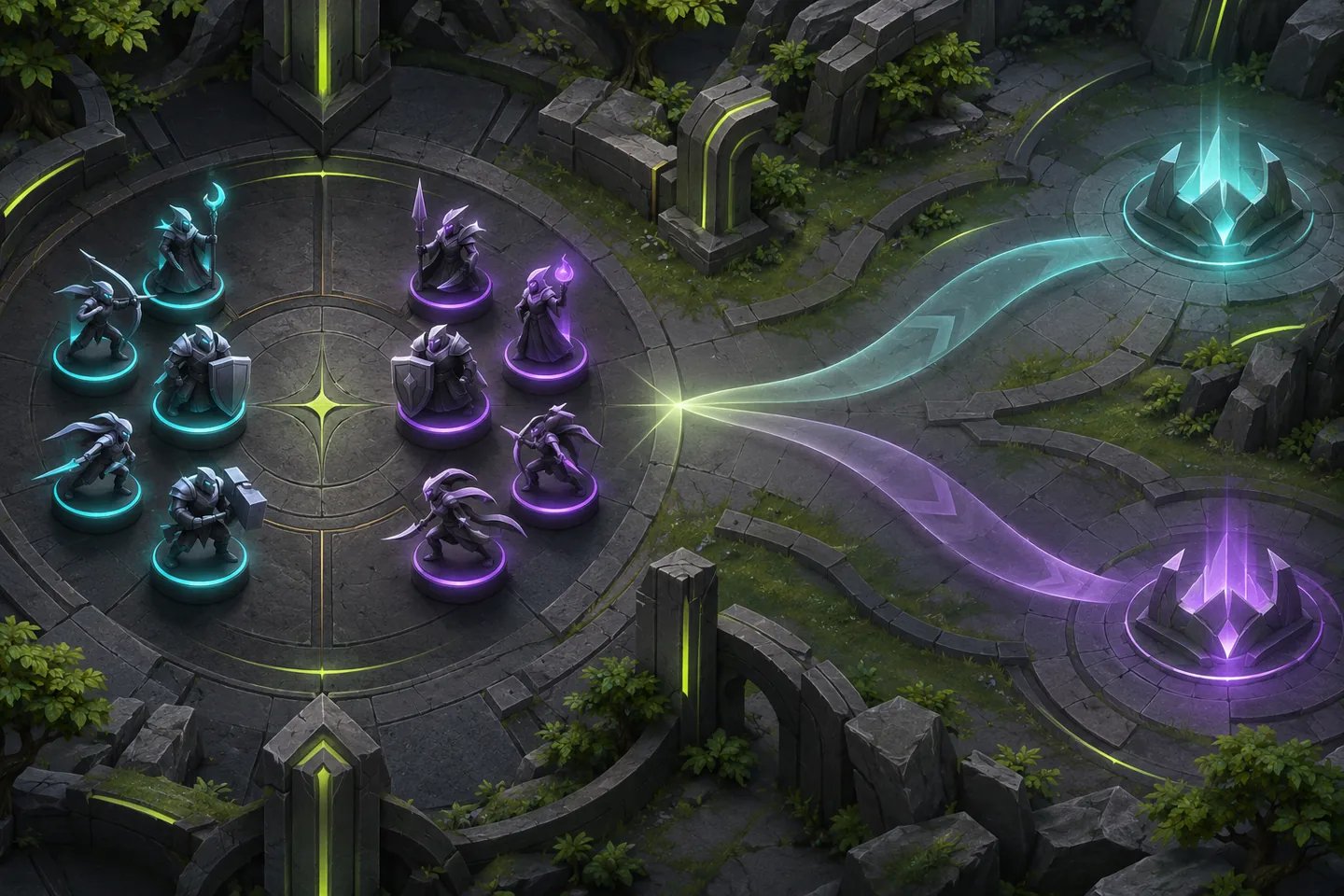
What makes a match feel even
Match balance in League of Legends can mean similar team ranks before play or a contest that feels close once it starts. A team might finish a match feeling it always had a chance. A player on the same side might remember long stretches when their choices felt limited.
Imagine two fictional five-player teams with ranks on a simple numeric scale. One has 6, 8, 10, 12 and 14. The other has 9, 10, 10, 10 and 11. Both average 10. The first lineup has a wider spread, even though the averages make the teams look identical.
The 2015 study paired ranks with player responses
Claypool and colleagues collected 52 complete responses from 23 players on the North American server in version 4.21. They gathered player ranks and asked participants to rate balance and enjoyment after their games.
The researchers compared the average team rank on each side. That calculation turns ten ranks into a single gap. In the fictional lineups, the gap is zero. It leaves open how the ranks are distributed across opponents who spend much of the match interacting with each other.
Close team averages could feel uneven
In over 80% of the study’s matches, the team averages were within one step on the researchers’ rank scale. Some respondents rated games as uneven when both averages were equal. The reported correlation between the rank gap and perceived imbalance was close to zero.
In the fictional example, a player could spend most of the opening facing the strongest opponent. Another could have room to set the pace elsewhere. Both experienced the same team averages and could give different answers when asked whether the game felt even.
How players rated wins and losses
After losses, respondents tended to judge the other side stronger. They reported more enjoyment after wins. The study gathered these ratings after the result was known.
A comeback can change how someone remembers an earlier setback. A match that ends in a loss can feel difficult because one side had few credible ways to recover. Both are possibilities. A single postgame rating leaves room for the events of the match and the result to shape the answer together.
Read the rank gap on its own scale
The campus sample included repeat participants. Researchers converted visible ranks to numbers. Internal matchmaking calculations and present-day queues fall outside the comparison.
Even a zero gap has a precise meaning in the invented example. It says two lineups have the same average on the chosen scale. Estimating each team’s chance of winning would require a model checked against many results from comparable lineups. The average by itself supplies no such estimate.
A match review can ask for a turning point
For a review exercise, record the team rank gap before play. Afterward, ask each player to rate perceived balance and name a moment that explains their rating. Write down the outcome too. If players point to different moments, their explanations show where to look in the replay.
A design study could also collect a rating at a fixed point before the result is known and compare it with a rating after the match. That proposed comparison would show how judgments change over the session. Comparing those changes with the replay would give a better account of what players noticed.
Keep exploring
Sources & further reading
- Claypool et al. (2015) · Full IEEE GEM study ↗
- Worcester Polytechnic Institute · Authors’ study page ↗
Have a correction? Tell our editorial team.