Chess Thinking Time: Read the Position Behind the Pause
Chess thinking time needs context. A 2026 study of professional games helps distinguish a long pause, the remaining clock and an engine-based quality measure.
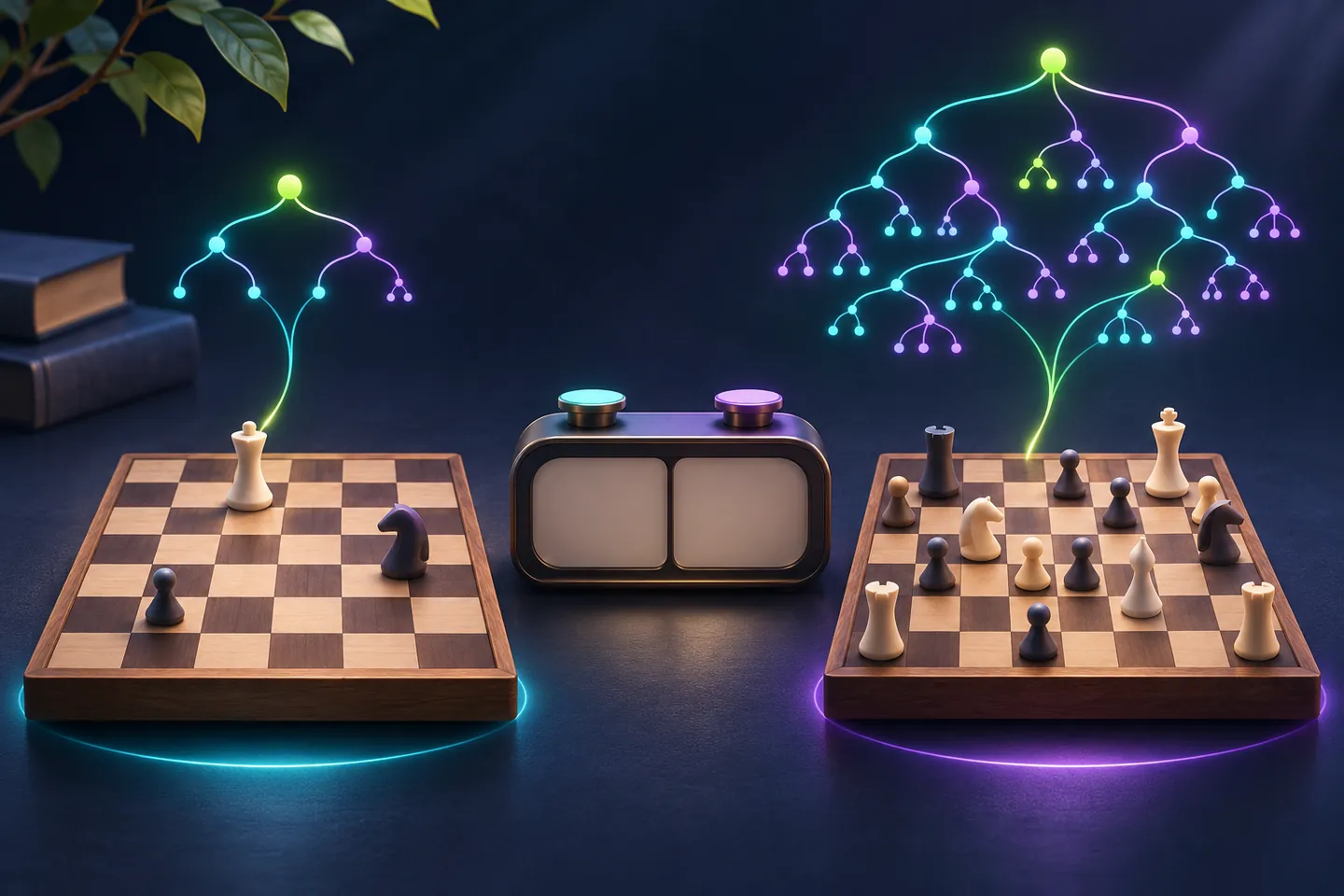
Attach the pause to the decision
Chess thinking time records how long a player takes before moving. To interpret it, keep the position and the remaining clock alongside the duration. A pause is an observation to investigate, rather than a complete explanation of why a move succeeded or failed.
Imagine a fictional game log with a five-second move that matches an engine’s choice and a ninety-second move that does not. The entries concern different positions. They cannot tell you what would have happened if the player had spent ninety seconds on the first decision or five on the second.
Read the professional-game sample carefully
Sunde, Zegners and Strittmatter’s May 2026 paper analyzed over 215,000 moves from professional games involving players rated at least 2500 Elo. It excluded each player’s first fifteen moves. Its main quality measure was whether the move matched Stockfish 17’s recommendation.
That measure needs a name when discussing a result. Matching a benchmark choice differs from winning the eventual game. An opening recommendation also answers a different question from an analysis that deliberately removes the early part of each game.
Keep the association separate from a timing rule
Longer decisions were associated with a lower probability of matching the engine’s choice in classical, rapid and blitz games. The association persisted with controls for remaining time, computational complexity and the gap between alternative moves.
The fictional log could contain a familiar, easily recognized continuation followed by an unfamiliar position with several plausible replies. Different demands could accompany the different pauses. To learn what an imposed time limit changes, you would need evidence comparing that intervention, rather than treating the existing durations as assigned instructions.
Separate thinking time from remaining time
Suppose two invented log entries both record a twenty-second decision. In one, the player started with ten minutes remaining. In the other, the player started with thirty seconds. The duration is identical, but the clock leaves very different room for the next decision.
For an original review exercise, keep those two fields separate. Also note whether time is added after a move under the selected game’s rules. A record that contains only the duration loses information about the budget within which the choice was made.
Leave unmeasured difficulty unresolved
This was observational research, without assigned thinking durations. Subjectively perceived difficulty was an interpretation, not a directly observed measure.
In the fictional log, ask the player what made a position difficult before supplying an explanation from its duration. Perhaps they were comparing two plans or checking one specific threat. Preserve that account separately from the engine analysis. Neither a long pause nor an evaluation score alone reveals which alternatives the person actually considered.
Review a move without inventing a universal stopwatch
Choose one decision you want to understand. Save the position, the move, its duration and the clock remaining beforehand. Write down what you recall considering, then inspect the analysis under a stated engine setup. These are proposed review notes, not a tested training protocol or evidence that they improve performance.
If the move differs from the engine’s recommendation, examine the continuation behind that judgment. Keep the question specific to this position. The professional-game association supplies a reason to investigate a pause’s context, while leaving the effect of giving this particular decision more or less time unanswered.
Keep exploring
Sources & further reading
- Sunde, Zegners and Strittmatter (2026): full PNAS study via PMC ↗
- Anthony Strittmatter: author publication record ↗
Have a correction? Tell our editorial team.