Memory Match Strategy: Remember Card Positions
Use this Memory Match strategy to remember card positions, turn a mismatch into a clue, and choose the second card in ProjectGAMR's 4-by-4 puzzle.
Give each card a short address
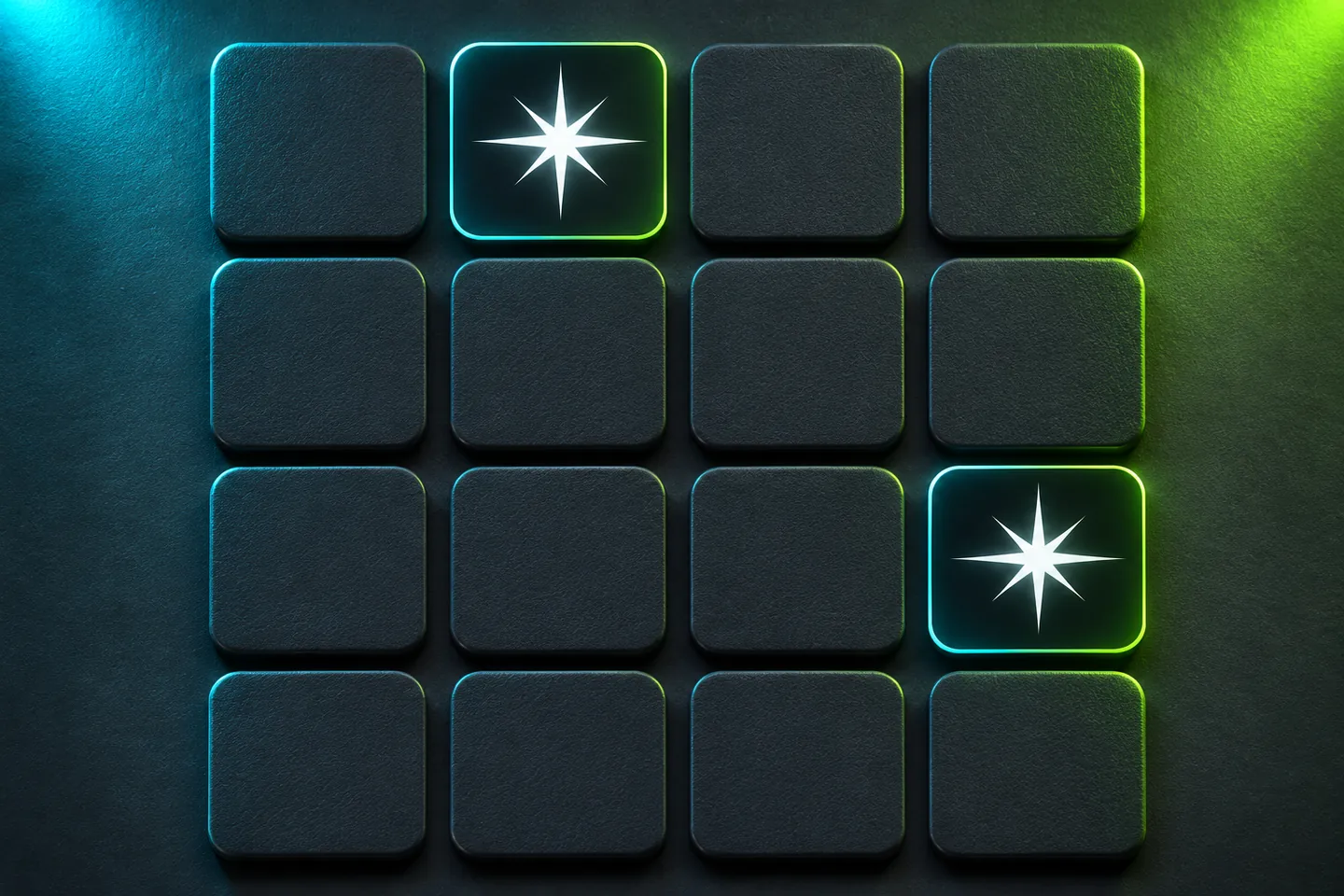
A Memory Match strategy starts with short labels for card positions. The rules here apply to the ProjectGAMR solo browser game checked on November 13, 2026. There are sixteen cards in a 4-by-4 grid and eight pairs to find. Two flips make a turn, whether the cards match or differ.
Label the rows A, B, C and D, starting at the top. Number each column from the left, starting at one. The top-left card is A1. The first card on the second row is B1. These addresses let you say “star at A1” without pointing back to the screen.
Record both positions after a mismatch
In a checked layout, A1 shows a star and A2 shows a sun. That turn finds no pair. The game briefly displays both cards and then turns them face down in the same places.
Use the pause to repeat the two addresses with their symbols. You can take time after the cards turn back, since this version has no timer or move limit. A mismatch gives you two places to check when their partners appear later.
Use a remembered card on the second flip
Start the next turn with the unseen B1. It shows a sun. Use the second flip on A2, where you saw the first sun. The pair stays face up, and the checked board now shows one pair in two turns.
The first flip can change your plan for the second. Look for the newly revealed symbol among the locations you remember. If its partner has a known address, use that address while the first card is still open.
Collect a known pair at the start of a turn
In the same layout, A3 reveals a diamond and B3 reveals a star. The cards differ, and you now know that the two stars sit at A1 and B3. Choose those two cards together on the next turn.
Both stars stay face up. Remove their addresses from the list of cards you still need to match. The unmatched diamond remains at A3. On the next turn, C1 reveals another diamond. Flip A3 to complete that pair.
Explore a new position when you lack a partner
When your first card has no remembered mate, use the second flip on an unseen card. It might complete the pair or supply another symbol and address for a later turn. Save previously seen cards with other symbols for when their own matching pairs turn up.
Velleman and Warrington describe this choice in their mathematical model of solo matching. They assume perfect recall. On the browser board, short labels let you apply the choice even when you remember only a few positions.
Track unmatched symbols until the board is clear
After each turn, keep the addresses of unmatched symbols and drop the pairs that stay face up. If both positions of a remaining pair are known, you can collect them before looking for new symbols.
The checked layout finished in ten turns, including two mismatches. New game shuffles the cards, so build a fresh set of addresses. Use the turn counter to review where you found a pair or learned a position.
Keep exploring
Sources & further reading
- ProjectGAMR Memory Match board and rules ↗
- ProjectGAMR published Memory Match implementation ↗
- Daniel J. Velleman and Gregory S. Warrington, Matching Expectations ↗
Have a correction? Tell our editorial team.