Split-Screen Co-op: Read Two Views as One Shared Plan
Explore split-screen co-op through It Takes Two and A Way Out: separate camera views, shared information and an original exercise for two players.
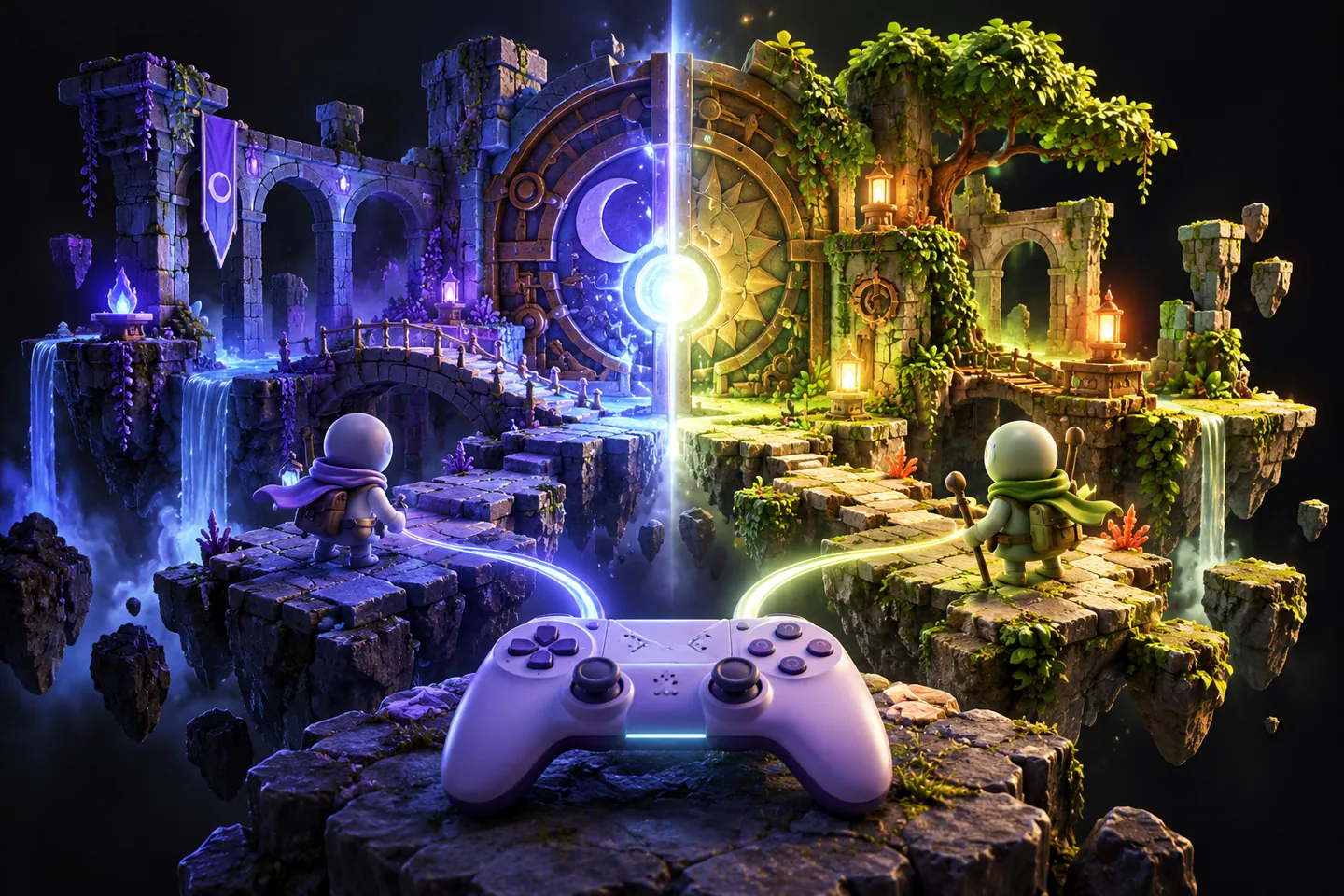
Treat the second view as part of the interface
Split-screen co-op can give a pair more than separate spaces for controlling their characters. When both viewpoints are visible, the other pane can reveal how your action changes your partner's surroundings. Ask which view contains the information needed for the next decision.
Separate character controls do not automatically mean private information. A partner may have a different role while both players can inspect the resulting scene. It Takes Two and A Way Out provide concrete examples of games designed around divided views. Their established features, checked here on October 27, 2026, support an interface comparison rather than a new-release claim.
Local and online describe the connection, not the framing
EA describes It Takes Two, first released in 2021, as a two-player adventure with split-screen in couch and online co-op. The divided presentation is therefore relevant even when partners are in different homes. The camera arrangement is a game-design choice alongside the connection method.
For the PS4 and PS5 versions, the current US PlayStation page identifies those platforms and requires PlayStation Plus for online play. Its FAQ separately confirms couch co-op without an internet connection. Those are the named version's conditions; a split-screen label alone supplies neither another game's local-player count nor its account or service requirements.
A divided screen need not keep the same shape
A Way Out's original June 10, 2017 announcement quoted director Josef Fares describing transitions between a full-screen presentation and different cinematic split-screen formats. EA's current co-op explanation still presents split-screen as central to the game, whether playing together on a couch or online. The historical announcement describes the design's origins, not a feature arriving today.
Consequently, avoid assuming that split-screen promises a permanent equal division. Framing can direct attention to different characters or moments. When discussing a layout, identify the scene and what each portion shows instead of turning one promotional image into a rule for the entire adventure.
Follow one action across two viewpoints
Consider an invented cooperative scene. One character turns a wheel while the other waits beside a rotating bridge. The first view makes the wheel's movement easy to see; the second makes the bridge's alignment clear. These are hypothetical roles, not a puzzle reproduced from either game.
If the question is whether the bridge is ready to cross, the wheel animation alone may be the wrong evidence. The partner's view can show the consequence that matters. Compare the two pictures as an action and a result: which object moved, where did it stop and which route is now visible? This uses the divided interface to inspect a relationship, without claiming that every co-op puzzle works this way.
Distinguish seeing an event from controlling it
Being able to watch a character does not grant that character's inputs. In the bridge sketch, one person can recognize a useful alignment in the second pane while the other remains responsible for crossing. Keep those two facts separate when deciding whether a problem concerns missing information, an unfinished action or a mistaken expectation about control.
For a short observation exercise, identify one detail available in each view before attempting the interaction. Afterward, ask which detail explained the outcome. If the game changes the framing, make that observation again. This is an editorial exercise for reading the interface, not a tested method for improving coordination or a claim about how much attention every player can divide.
Read the actual arrangement before generalizing
Keep three descriptions available: who controls each character, which viewpoints are visible, and how the scene is divided at that moment. Those details explain more than simply calling a game cooperative. Two different abilities can appear within shared visual information, while another game may deliberately keep a partner's view unavailable.
For these Hazelight examples, the second view is part of the presentation to interpret. Use it where it answers your current question, then return attention to the action you control. A successful shared sequence can be worth understanding without turning it into a promise about stronger friendships, superior performance or the design of every console co-op game.
Keep exploring
Sources & further reading
- EA: It Takes Two features, couch and online split-screen ↗
- PlayStation US: It Takes Two PS4/PS5 requirements and FAQ ↗
- EA Originals: A Way Out, a cinematic co-op game ↗
- EA: Original A Way Out announcement and cinematic framing, June 10, 2017 ↗
Have a correction? Tell our editorial team.