Why We Play: Understanding Player Motivations
Explore achievement, connection, discovery and choice in games, using original motivation studies without squeezing every player into a type.
One game, several reasons to play
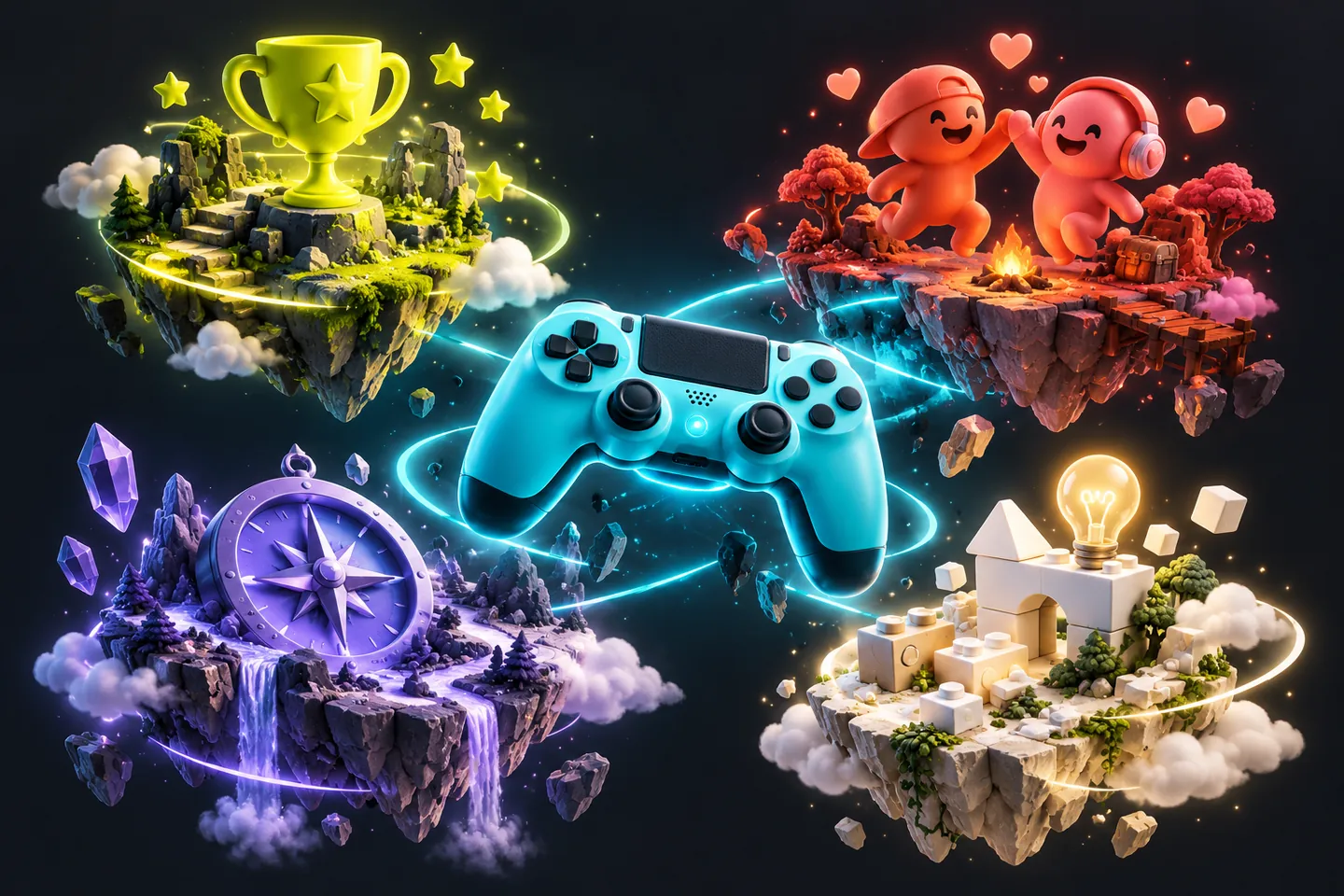
Two people can play the same game for completely different reasons. One wants a difficult puzzle, another wants time with a friend, and a third wants to experiment with an unfamiliar strategy. Even one person can want different things on different evenings. A useful account of motivation therefore starts with the experience someone seeks, rather than assuming that a title, rank or favourite character reveals a permanent player identity. Ask what would make this particular session feel worthwhile.
A model built from MMORPG players
Nick Yee’s 2006 study used questionnaire data from roughly 3,000 MMORPG players to investigate relationships among reported motivations. Its analysis grouped ten components under achievement, social and immersion. The important idea for a reader is that these dimensions can coexist. Someone can enjoy improving a character and developing friendships at the same time. The model describes patterns within its sample and questions; it is not a universal inventory of every possible reason to enjoy every kind of game.
Competence, choice and connection
Ryan, Rigby and Przybylski’s 2006 paper tested a self-determination theory approach across four studies. It examined perceived competence, autonomy and relatedness in game experiences, finding relationships with enjoyment and play intentions. These concepts offer another perspective: feeling capable, having meaningful choices and feeling connected can matter alongside a game’s theme. They do not prove that every feature creates enjoyment for every player, or that playing a particular genre automatically satisfies any particular need.
Translate the idea into a session
Treat the following as a reflection exercise, not a psychological test. Before starting, choose a modest intention: learn one chess opening principle, solve a Sudoku without hints, or share a relaxed Chinese Checkers match. Afterward, ask whether the session delivered that experience. If a competitive queue feels mismatched with an evening intended for conversation, choose a different activity next time. This is a practical way to articulate preferences without awarding yourself a supposedly scientific personality label.
Separate motivation from skill and time
Wanting to improve does not mean already being highly skilled. Enjoying a story does not mean disliking competition. Playing many hours does not, by itself, explain what those hours meant. A match history can show outcomes and actions while leaving the player’s intention unclear. Likewise, a self-report questionnaire reflects how people answer particular questions at a particular time. Combining different forms of evidence can answer richer questions, but it also requires care about how the measures connect.
Use models as conversation starters
The cited work comes from specific studies, populations and game contexts, including online role-playing games. It should not be silently generalized to every age group, browser puzzle or modern multiplayer community. Our suggestion is simple: use a model to make a better question. Ask a teammate whether they want to learn, compete or explore before choosing a mode. Accept mixed answers and changing preferences. You can understand what somebody wants from a game without claiming that you have classified who they are.
Try keeping the question specific enough to answer without a score: which moment would you like to experience again? An answer about a clever solution, a shared joke or a close finish can be more useful for planning another session than a broad label.
Sources & further reading
- Nick Yee (2006): Motivations for Play in Online Games ↗
- Ryan, Rigby and Przybylski (2006): The Motivational Pull of Video Games ↗
Have a correction? Tell our editorial team.