Tetris Piece Rotation and the Moves Players Undo
Tetris piece rotation can help a player inspect a fit before committing. A 1996 study tracked extra turns and showed why a move count needs context.
What a turn can show
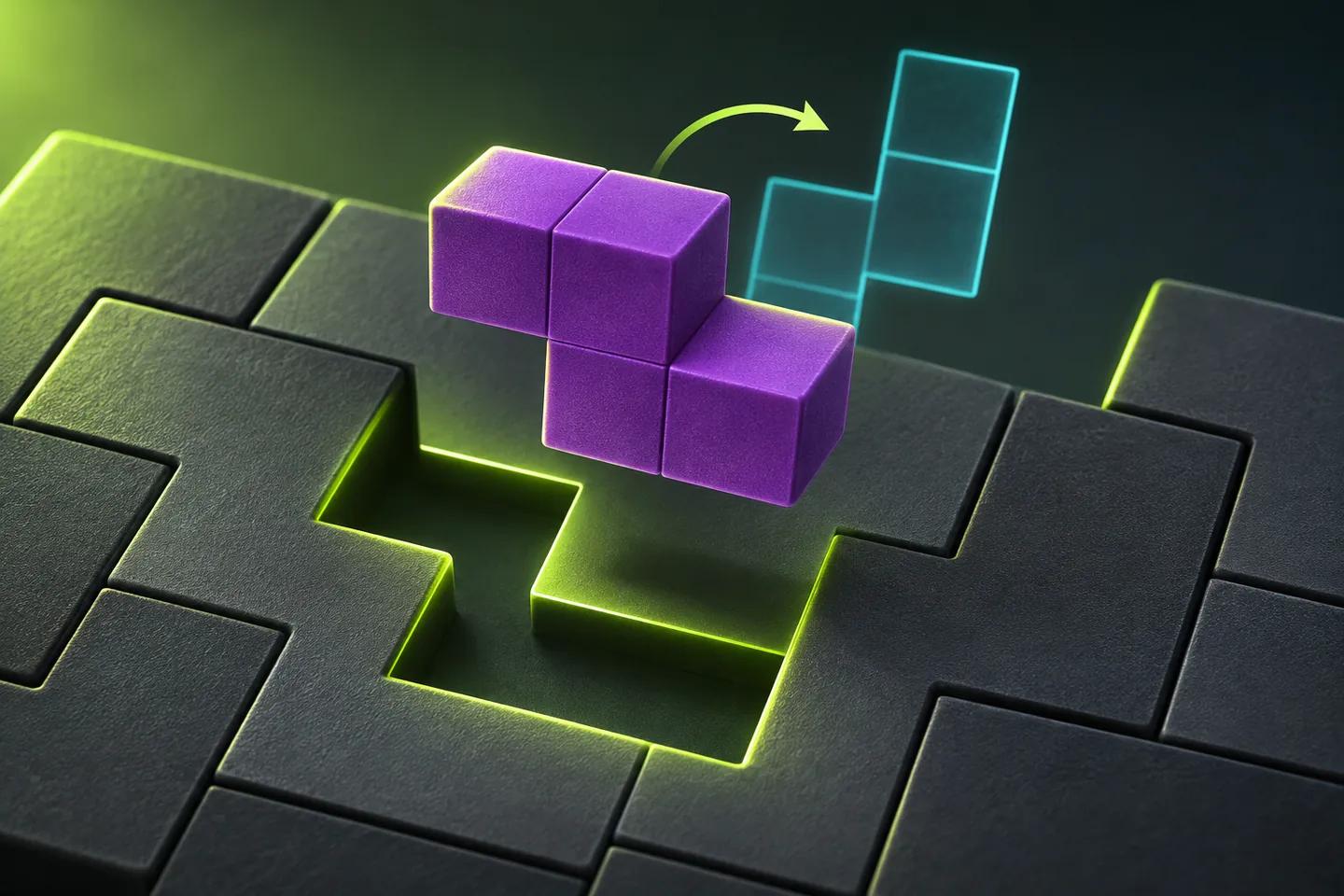
Tetris piece rotation changes what a player can see before a piece lands. An L shape held flat can be hard to compare with an upright gap. Turning it provides an outline the player can check against the stack while the piece is still movable.
Imagine an untimed puzzle with an opening three squares tall and one extra square to the right of its bottom. Above the stack, you rotate a horizontal L shape until it stands upright. Its foot points left, so you rule out that orientation, turn the piece back and choose another opening. The final board preserves the placement. The rejected orientation helped you choose it.
How the researchers counted extra turns
In 1996, Paul Maglio and David Kirsh logged about 20 hours each from two Tetris newcomers. In slow episodes they counted turns beyond the minimum needed for the final piece placement.
In the example, the piece starts and lands horizontal. If there is room to carry it to its destination without turning, the upright trial and the return to horizontal add rotations beyond what the final placement requires. That count would be the same whether you inspected the gap or simply pressed the wrong key.
Faster play and extra rotations coexisted
Both players became quicker on the study’s timing measures. The paper details extra rotations for one of them, identified as LA. In three consecutive six-hour blocks, LA made extra rotations in 4%, 5% and 7% of the slow episodes, respectively.
The percentages count episodes containing an extra turn. A small share of placements can include such a turn even if the typical placement is direct. A player might inspect a shape only when two gaps look plausible. That possibility would be hard to see in a tally of every rotation across an entire game.
A turn can help answer a question
Kirsh and Maglio’s 1994 paper describes an epistemic action as one that helps a person obtain or use information.
Suppose your fictional stack offers two openings. One looks promising until you turn the shape and see a square sticking out. That failed fit lets you cross one option off before you move sideways. If the shape is already near the stack and about to land, the same check could leave too little time to steer.
A keypress leaves room for several explanations
For LA, extra turns were no more frequent to a statistically significant degree when a mirrored shape would fit without leaving a hole but the actual piece could not.
An unplanned keypress, a changed plan and a deliberate check can leave the same trace. The logs do not identify the reason for an individual turn or show whether it saved time. The detailed pattern comes from one player in one setup, with no comparison that assigned players to rotate more or less.
Separate seeing the shape from moving it
A designer could test an optional outline that shows another orientation while the falling piece stays put. Keep the gaps and rotation controls the same with and without the outline. Record the turns players make, how long they take to commit and where the piece lands.
That comparison could show whether an extra view changes decisions when players can still rotate the active piece. The same landing square could follow a quick preview or several attempts at turning. Those are different ways to reach the fit, even if the board ends up looking identical.
Keep exploring
Sources & further reading
- Maglio and Kirsh (1996) · Epistemic Action Increases With Skill ↗
- Kirsh and Maglio (1994) · On Distinguishing Epistemic from Pragmatic Action ↗
Have a correction? Tell our editorial team.