Hybrid Board Games: Which Tasks Should the App Take Over?
Hybrid board games can hand timing and card handling to an app. A 2025 pilot study helps separate useful assistance from changing the activity.
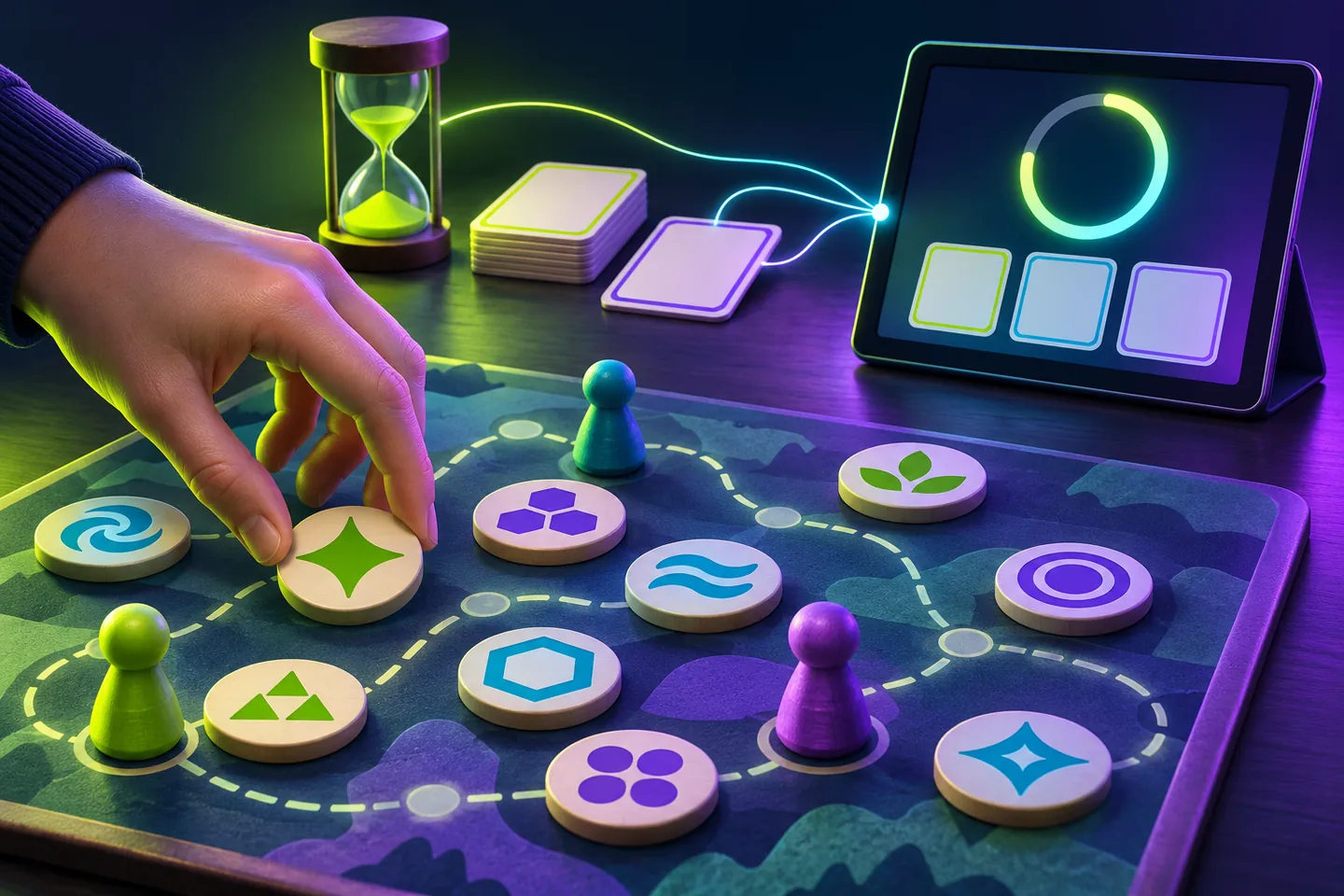
Follow the task from table to screen
Hybrid board games combine physical components with software. The interesting design question is what happens to the activity when a task moves between them. An app that keeps time and an app that chooses a move can both remove an action from the table while leaving very different responsibilities behind.
Imagine a fictional treasure hunt with a map, clue cards and a countdown. Players enjoy discussing which landmark matches a clue. Someone also watches the clock. Handing the countdown to a phone leaves the discussion available. Having the phone identify the landmark would take over part of that discussion.
One pilot kept the physical search
Sasha Soraine and Melissa J. Rogerson’s 2025 pilot involved sixteen people playing both versions of Spy Guy: Fantasy in pairs. Eight began with the published version and eight with a custom app version. The app replaced cards and the sand timer, retaining the physical board and markers. Surveys followed each version, then group interviews.
A component-level comparison asks a narrower question than replacing the entire activity. In the invented hunt, changing how a clue arrives can leave the interpretation of that clue with the group. Automating the answer would create a different comparison.
Keep the null result beside the interviews
The paper reports no significant within-person differences between versions. Interviews nevertheless described an overall preference for the app, with object-finding treated as central and monitoring time as supporting work.
Those accounts help explain what people valued. They do not turn a null statistical result into proof of improvement or equivalence. A person can describe one convenient feature without producing a clearly different overall survey response. The two records can be informative together.
The same action can carry a different purpose
Return to the fictional treasure hunt. Suppose players draw a clue simply to reveal their next target. Automating that reveal could preserve the uncertainty about which clue appears. Now suppose choosing a clue from several visible cards is a negotiation. Automating the choice would remove that negotiation.
Both changes might be described as digital card handling. Writing down the decision that remains makes the description more useful. Who sees the alternatives? Who chooses? Who knows why a clue appeared? A component’s physical form alone cannot answer those questions.
Order and presentation bound the comparison
The researchers found some survey differences between play-order groups and noted that second responses implicitly compared experiences. The app also bundled timing with audiovisual feedback. Sixteen participants in one short game provide a limited basis for broader claims.
Trying a second version gives someone a reference they lacked during the first. A different response may involve that comparison. Likewise, replacing sand with a screen can change several cues at once. Crediting software alone would skip the question of which change the person actually noticed.
Describe the responsibility that remains
For our invented hunt, a clear description would say that the phone reveals clues and announces time while players interpret landmarks together. That names the division of work. It also makes a later redesign easier to discuss: automatically solving a clue changes a responsibility that announcing the timer leaves with the group.
Ask what participants want to keep doing before treating every repeated action as disposable. That is a design question, with an answer tied to the activity and its players. Both linked sources document this pilot.
Keep exploring
Sources & further reading
Have a correction? Tell our editorial team.