Elden Ring Bloodstains and the Limits of a Player Map
Elden Ring bloodstains show brief player replays. A 2022 survey mapped those traces and helps explain why a cluster alone cannot measure a route’s risk.
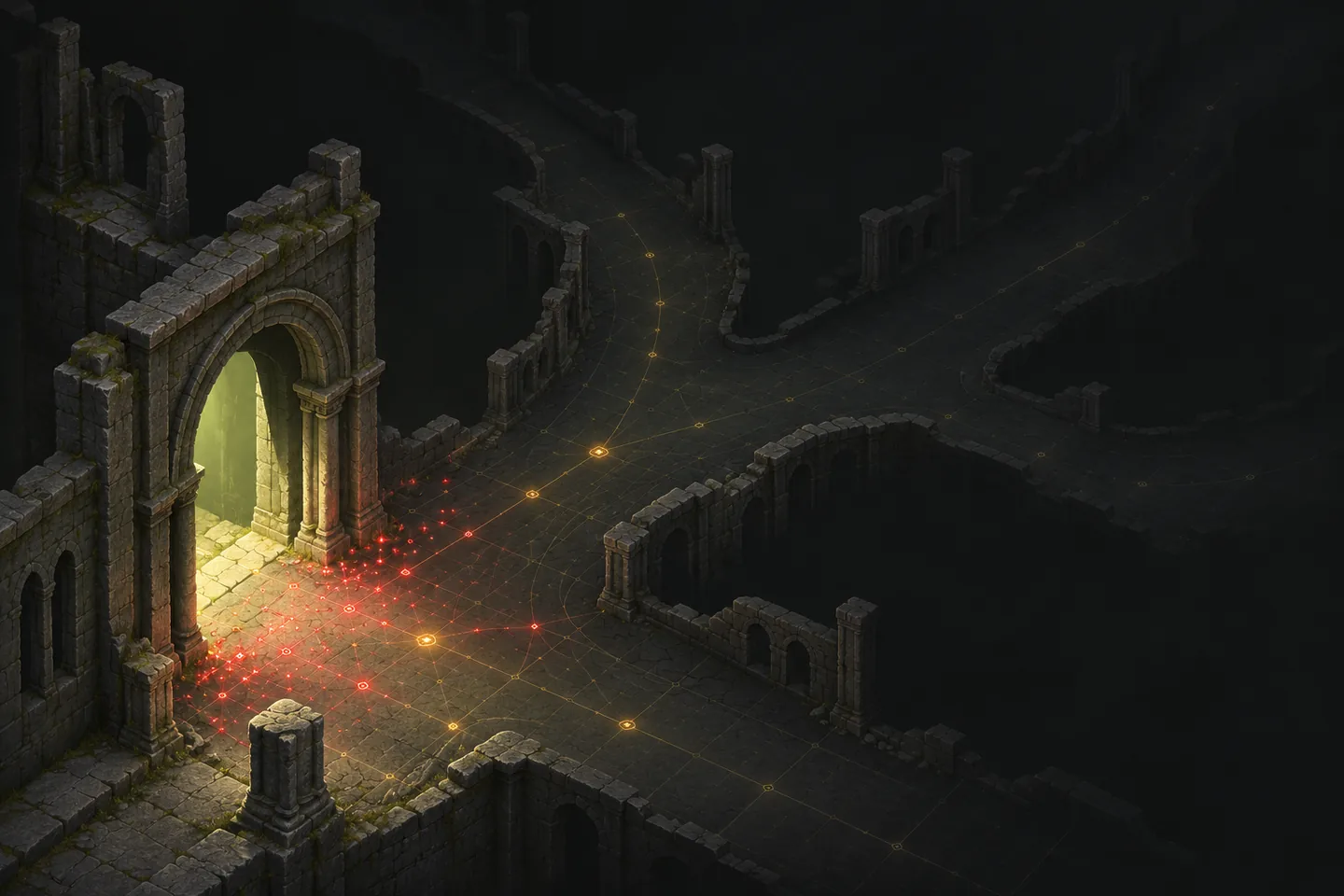
A mark can show the end of an attempt
Elden Ring bloodstains replay the last moments of another player’s attempt. The ghost shows the character’s movements, with enemies and effects omitted.
Picture an invented corridor with a narrow doorway. A replay shows someone rushing through, stopping abruptly and falling. That sequence gives you a reason to look at the doorway. To tell whether the player missed a step or reacted to something around the corner, you would need more of the scene.
Two sites surveyed in March 2022
Smith Nicholls and Cook surveyed the Church of Elleh and a Limgrave catacomb corridor on PC and PS4. Using plans and screenshots, they documented 40 records of bloodstains and player messages outside the pilot.
The position of a marker gives it context. In the invented corridor, a mark beside a doorway and one at the far end tell you to look in different places. On a sketch of the passage, you could draw the door, the mark and the direction the ghost moved. A dot by itself leaves most of that context out.
Read the movement beside the setting
A recorded ghost ran down a corridor and died just short of a safe spot. From its path and timing, the researchers suspected a fire trap.
That reading gives the movement a plausible explanation. If a second ghost falls in the same place after approaching from the opposite direction, its path gives you another detail to account for. On the fictional map, you could write “fell beside the door” first and keep possible causes beside it as questions.
Why visible marks can change
During the survey, bloodstains and messages could appear or vanish between observations. Bandai Namco’s multiplayer guide also says a Group Password can prioritize traces from players who share it.
When asynchronous multiplayer brings another player’s trace into the scene, the marks you see reflect what was displayed on that visit. A return to the same corridor can offer a different set of clues. If you keep a map, adding the observation time and settings preserves information that a screenshot of the floor might leave out.
A count needs the number of attempts
Imagine a game designer can see every crossing. Twelve failures in 600 crossings give a rate of 2%. Six failures in 60 crossings give a rate of 10%. The passage with fewer failures in total has the higher failure rate in this example.
A player sees even less than the failure total in that example. The visible traces supply a sample of incidents and leave out successful crossings. A cluster can point to a place worth inspecting. Comparing the risk of two routes requires the attempts behind the marks and some way to account for what the game displays.
Keep the map tied to the question
For a small observation exercise, sketch one threshold and note which movements are visible in each replay. Record a nearby warning as a player’s message, with its location. The message and the movement can point to the same object, while each still offers a different kind of evidence.
If the question is where to pay attention on your next visit, the sketch can help you pick a spot. To compare risk across routes, a separate study would need to count crossings and their outcomes under defined conditions. The 2022 survey documents what could be seen on its visits to two sites.
Keep exploring
Sources & further reading
- Smith Nicholls and Cook (2022) · Full study manuscript ↗
- Bandai Namco Europe · Elden Ring multiplayer guide ↗
Have a correction? Tell our editorial team.