City-Builder Water Systems: Think Beyond the Capacity Bar
Read city-builder water systems as models: separate capacity, demand, quality and maintenance, then explore why real water operations require measured inputs.
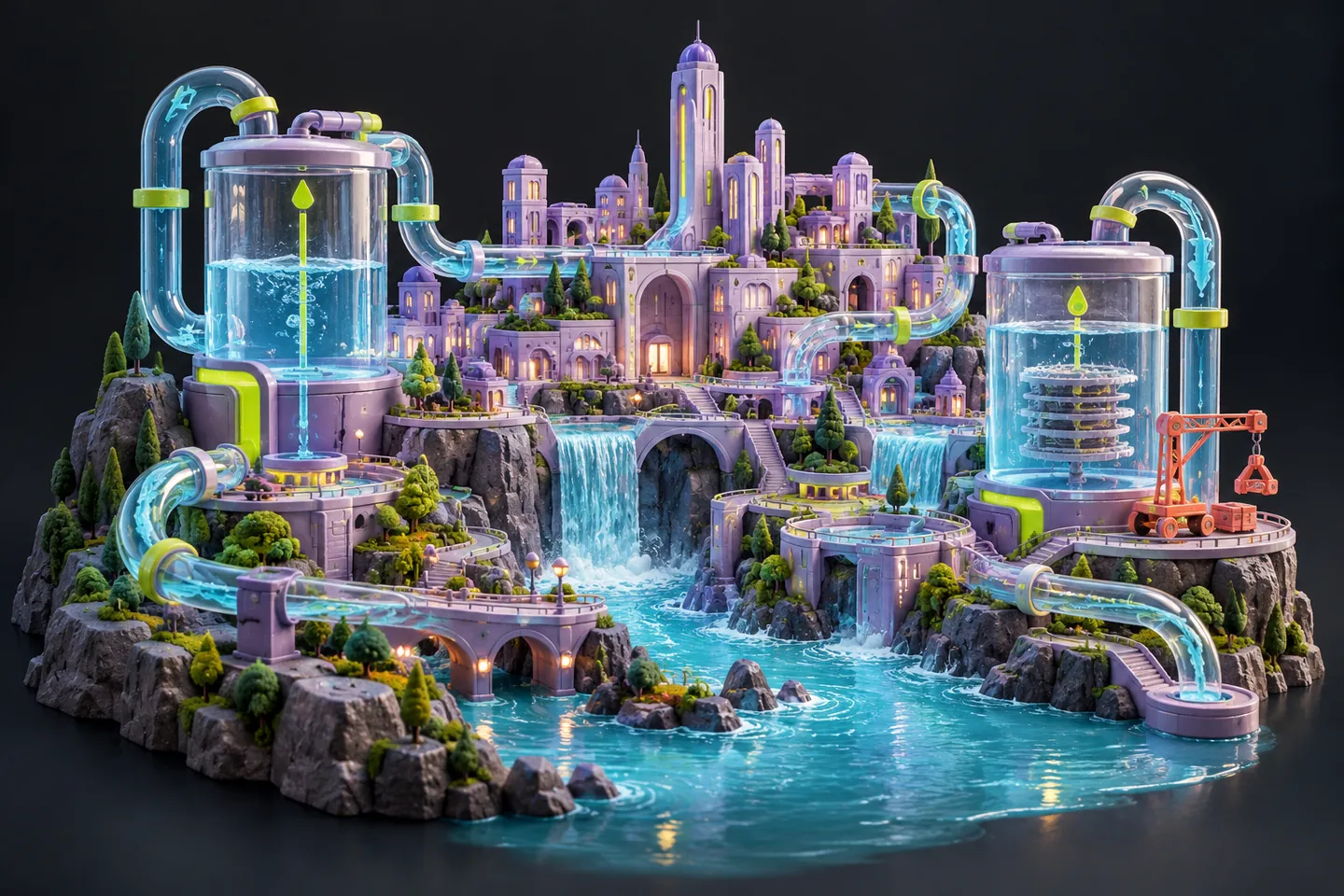
Ask what the simulation is counting
A city-builder water system becomes more interesting when you ask what its numbers represent. A capacity bar might combine several real processes into one convenient game mechanic. Before optimizing it, identify the game's actual rules: what increases demand, what interrupts supply and which changes the simulation ignores.
That is a useful reading exercise even when the game deliberately favors simplicity. A model can support an enjoyable planning challenge while leaving out details that would make play slow or confusing. The important step is recognizing the model's boundary rather than assuming every visible pipe represents a complete engineering system.
Separate spare capacity from future demand
Use a fictional example with game units. A city has capacity of one hundred units and current demand of eighty, leaving twenty units spare. If a planned neighborhood adds twenty-five units of demand, the new total is one hundred and five. The current green indicator alone would not reveal that future shortfall.
Now change one assumption at a time. Perhaps construction happens before the new facility becomes available, or a temporary outage reduces capacity. Write down the sequence instead of considering only the final arrangement. These invented values explain planning inside a model; they are not estimates for an actual water network.
Keep volume and quality as different questions
Moving enough water and treating it appropriately are separate questions. The U.S. Geological Survey's Water Science School explains that wastewater from homes, businesses and industry needs treatment before release to the environment. Its overview connects treatment with the protection of waterways and the living systems that depend on them.
For a game, check whether quality is modeled separately from volume and whether different sources produce different effects. If a single upgrade instantly resolves every warning, that is information about the game's abstraction. It is a reason to read the rules closely, rather than to infer how a real plant operates.
Look at the inputs real tools ask for
Corporativo Integral del Ambiente publishes water-treatment tools that illustrate a different level of detail: calculations, comparisons and operating records with explicit units and inputs. Its collection includes cost and consumption tools as well as ways to document tests and maintenance. The interesting connection is the information each task requires.
Compare those inputs with a game's simplified panel. Which values would need to be measured? Which assumptions would need to be confirmed? The tools provide a window into the questions professionals organize; a browser calculation or a game result does not determine a treatment decision, validate a chemical dose or establish compliance.
Treat maintenance as part of the system
In your next city-building session, reserve time to inspect dependencies. A new district might rely on one connection, one power source or one facility. Where the game permits it, compare a resilient layout with a cheaper layout that has a single point of failure. Record which tradeoffs the simulation actually rewards.
Keep a separate column for things the game does not model. Those omissions are not automatically design faults; a game needs a manageable set of decisions. But noticing them helps you describe what you learned precisely. You practiced reasoning about this model, under these rules, with these particular consequences.
Turn a play session into a better question
Choose one decision to investigate: when to expand, where to add a connection or how to respond to an outage. Save your prediction before changing the layout. After the simulation runs, compare the result with the prediction and name the rule that explained the difference.
Then write one question you would ask outside the game, such as how demand is measured or how maintenance is documented. Finding a good question is a worthwhile result. It preserves the curiosity that makes simulation games engaging while leaving real operational decisions with the people, measurements and procedures they require.
Keep exploring
Sources & further reading
- USGS Water Science School: wastewater treatment and water use ↗
- CIASA: water-treatment calculators and operating records ↗
- Corporativo Integral del Ambiente: company and professional scope ↗
Have a correction? Tell our editorial team.