Spider Solitaire Stock Deals: Fill Empty Columns First
Plan Spider Solitaire stock deals around empty columns. Move a descending run, reveal a hidden card and check what the next row covers in one-suit Spider.
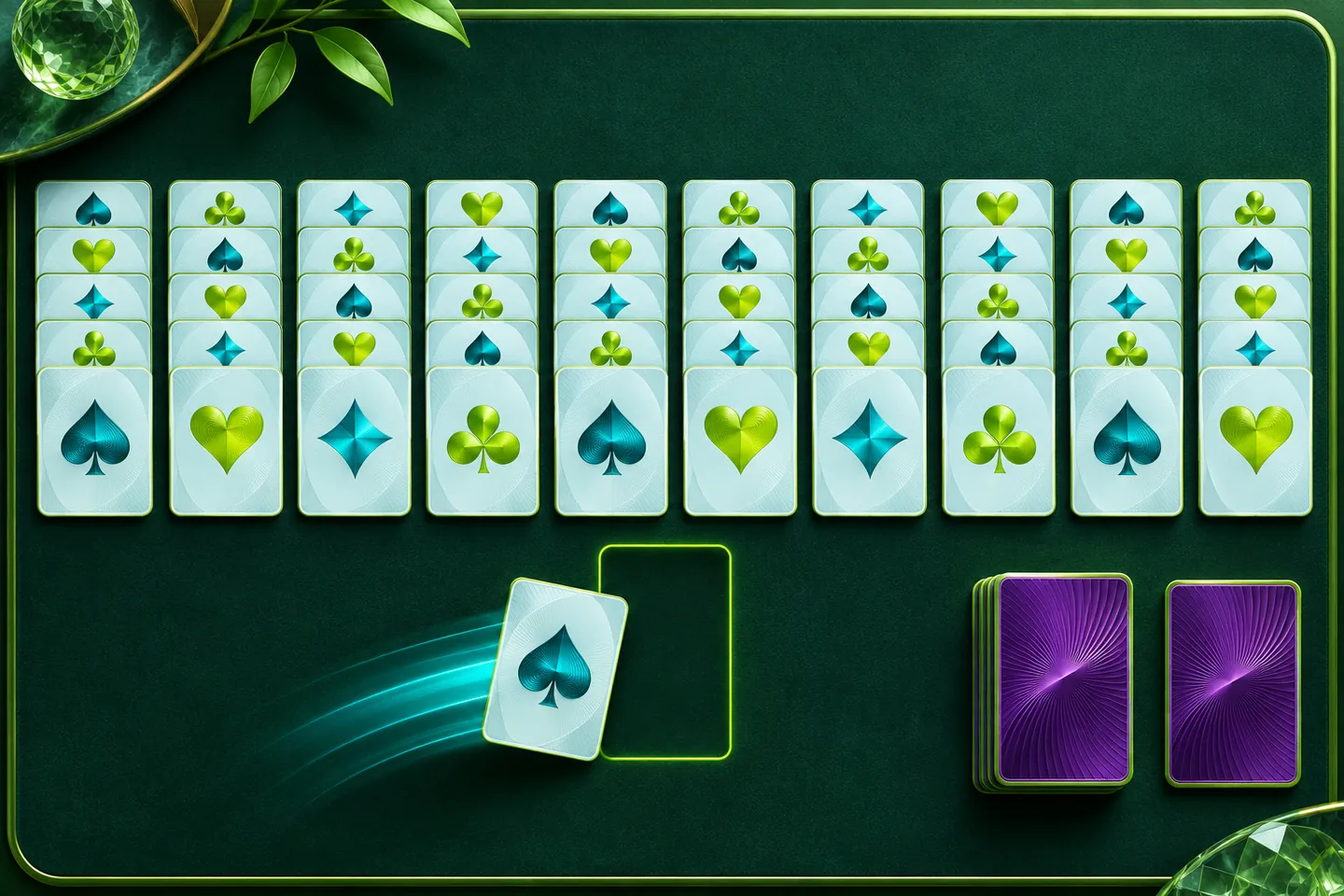
Read the stock count and check the gaps
Spider Solitaire stock deals add ten cards at once in ProjectGAMR’s one-suit Spider. The board tested on November 16, 2026 opened with ten columns and five deals in reserve. Each stock row adds one face-up card to the end of every column.
Fill all empty columns before dealing. Arkadium documents the same requirement for its Spider game. In the ProjectGAMR layout, a gap can hold a single face-up card or a valid descending run. Check what filling the gap would change before you commit.
Keep track of which column would become empty
In one checked board, column 1 became empty after a series of moves exposed its last card, an 8. The 8 went onto the 9 at the end of column 2. Selecting the stock with column 1 empty left the board and its five remaining deals intact.
Moving a whole column into the gap would leave a new gap at the source. To get ready for a stock row, look for a move that leaves a card behind. A transfer from a longer column may reveal another face-down card at the same time.
Use a descending run to fill the gap
In the checked layout, column 8 ended in a Jack and column 9 in a Queen. Put the Jack on the Queen to make Q–J. Then select the Queen and choose the numbered control for empty column 1. The two cards move together.
Column 9 now ends in a 2 that was face down. This move fills the gap, keeps Q–J together and lets you see another rank before deciding whether to deal. Use that new information to check for another useful transfer.
Inspect the column ends before dealing
You can deal once each column is occupied and stock remains. Before choosing Deal ten cards, look at the last card of each sequence you plan to move. It will have a new card under it, and that card may interrupt the sequence.
In the test, the deal reduced the reserve from five to four and put a 6 below Q–J in column 1. The 6 interrupts the rank order, so selecting the Queen no longer picks up the run. Moving the 6 onto the exposed 7 in column 10 made Q–J selectable again.
Use Undo to examine the decision
Undo can reverse the stock deal. In the test, undoing the 6 transfer and then the deal put ten cards back in reserve and restored the count to five deals. Q–J could be selected together again, and the 2 in column 9 stayed exposed.
Use this comparison to see which run the deal covered. If Q–J already had a useful destination before dealing, you can examine that move first. Recheck the column occupancy after each transfer.
Choose when the stock should enter play
Ask what the gap can help you do now. A move into it can uncover a rank or shift an intact run. When you want the next row, confirm that the source still holds a card and that the other nine columns are occupied.
After dealing, read the ten new ends before selecting a run. The objective is to clear eight complete King-to-Ace runs. Each stock row changes which cards you can reach next.
Keep exploring
Sources & further reading
- ProjectGAMR Spider Solitaire board and rules ↗
- ProjectGAMR published Spider Solitaire implementation ↗
- Arkadium developer support for Spider Solitaire ↗
Have a correction? Tell our editorial team.