Reversi Strategy: Corners and Mobility
Learn legal Reversi flips, why corners stay yours and how to compare mobility. Replay a valid opening and stop treating every big early flip as progress.
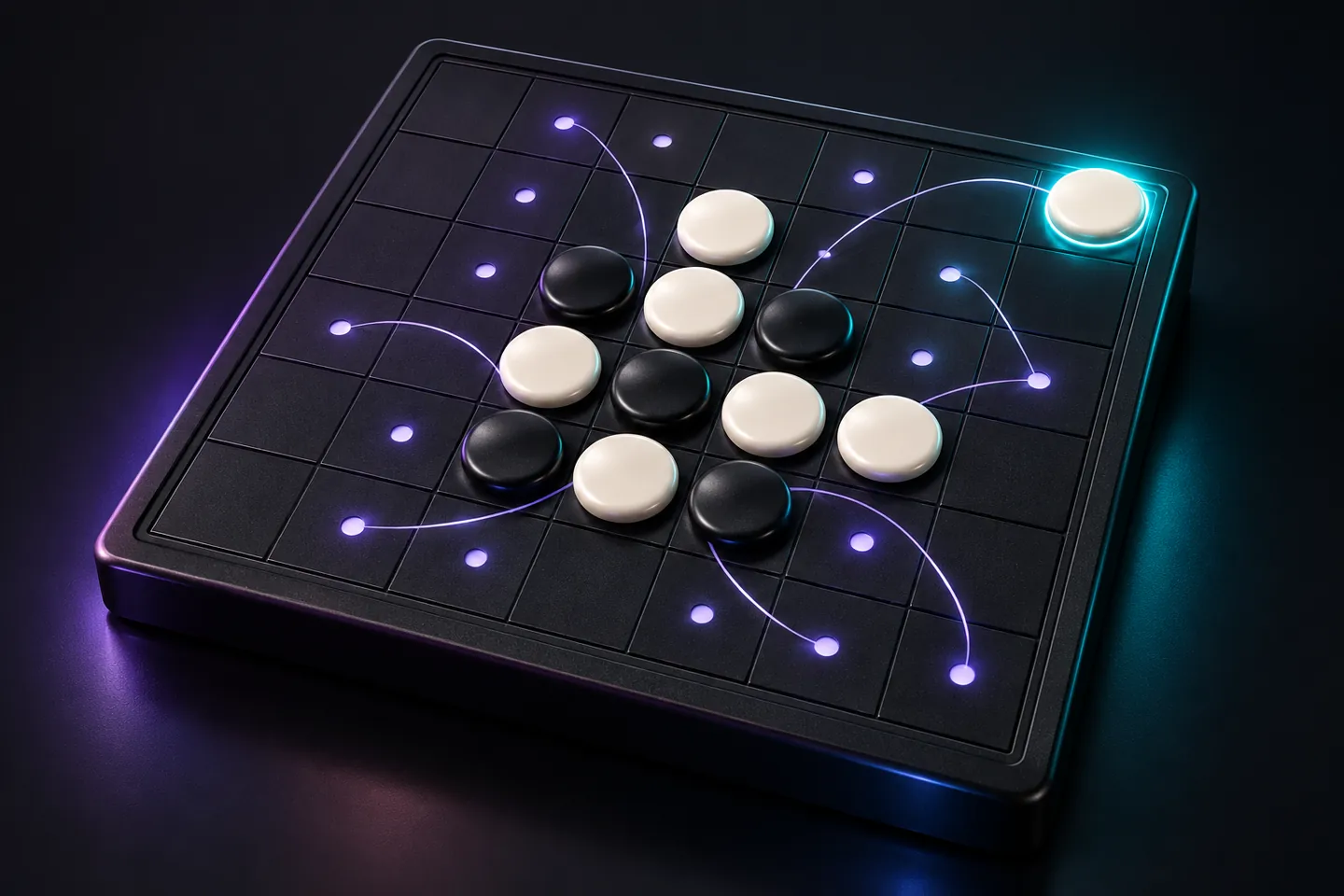
Know what a legal move changes
This guide uses the standard eight-by-eight Reversi setup also used in Othello: White starts on d4 and e5, Black on e4 and d5, and Black moves first. A legal placement brackets at least one uninterrupted line of enemy discs between the new disc and an existing friendly disc. All bracketed lines flip.
If you have no legal move, you pass; you cannot pass when a move exists. The game finishes when neither player can move, and the larger disc count wins. The World Othello Federation source below defines these rules. The browser game uses original presentation and local two-player play.
Replay a legal opening
From that starting position, Black can play c4. Along row four, the new c4 and existing e4 bracket White’s d4, which flips to Black. White can answer c3: along the diagonal c3–d4–e5, d4 is now Black and e5 is White, so d4 flips back.
Notice what did not happen. Discs do not flip because they are surrounded in a loose shape, and a newly flipped disc does not trigger a chain reaction in a new direction. Trace straight lines outward from the newly placed disc only. This makes both move legality and the resulting position predictable.
Why a corner cannot be flipped
A corner disc cannot be bracketed: there is no square beyond it on the far side of any line. Once you legally claim a corner, that disc remains yours. This geometric fact is why corners deserve attention well before the board fills up.
Taking a corner can also help secure connected edge discs, but avoid the claim that every edge disc instantly becomes permanent. Trace possible future brackets. A safe corner is valuable; an edge segment with gaps may still be reversible. Evaluate what is actually connected and which squares remain open, rather than treating the entire border as automatically protected.
Do not hand over the corner entrance
Squares next to an empty corner can become dangerous footholds for your opponent. The diagonally adjacent square is often called an X-square. Near a1, that square is b2. Placing there may let the opponent bracket along a diagonal and claim a1 later, depending on the rest of the line.
This is a warning, not an absolute ban. A particular b2 move may be safe or even necessary when the diagonal contains no usable bracket or the corner cannot be reached. Before playing beside an empty corner, test the opponent’s legal corner move on the resulting board. Geometry beats a memorized slogan.
Compare mobility before disc count
Mobility is the number of legal moves available. If a move leaves your opponent only awkward choices, you may control where the game goes even while owning fewer discs. Conversely, a large early flip can expose many new placements around your color and increase the opponent’s options.
To compare two moves, imagine the flips, then count the opponent’s legal replies. Check the quality of those replies too: five harmless moves may be better for you than one move that claims a corner. A simple count is a useful starting measurement, not a complete evaluation of a complex position.
Change priorities near the finish
Early in the game, flexibility can matter more than maximizing your current discs. At the end, the final count decides the result. In a small remaining region, calculate legal replies instead of assuming the move that flips the fewest is always best. A forced pass can change who plays the last available square.
For local practice, pause after ten turns and count each side’s legal options. Later, with only a few empty cells, try reading the sequence to the end. Review one move that surrendered a corner or removed your last good option. That gives you a concrete target for the next game.
Sources & further reading
Have a correction? Tell our editorial team.