Peg Solitaire Strategy: Plan the Last Two Jumps
Build a peg solitaire strategy around the last two jumps, with a checked three-peg example, an isolated-peg trap and the English cross rules.

A peg solitaire strategy needs a useful finish
Removing a peg is easy to count; leaving a position that can still finish takes more thought. A useful peg solitaire strategy starts by describing the final jump, then asking which earlier arrangement could supply it. The destination needs to be empty, the jumping peg needs a neighbor, and all three holes must lie on the board.
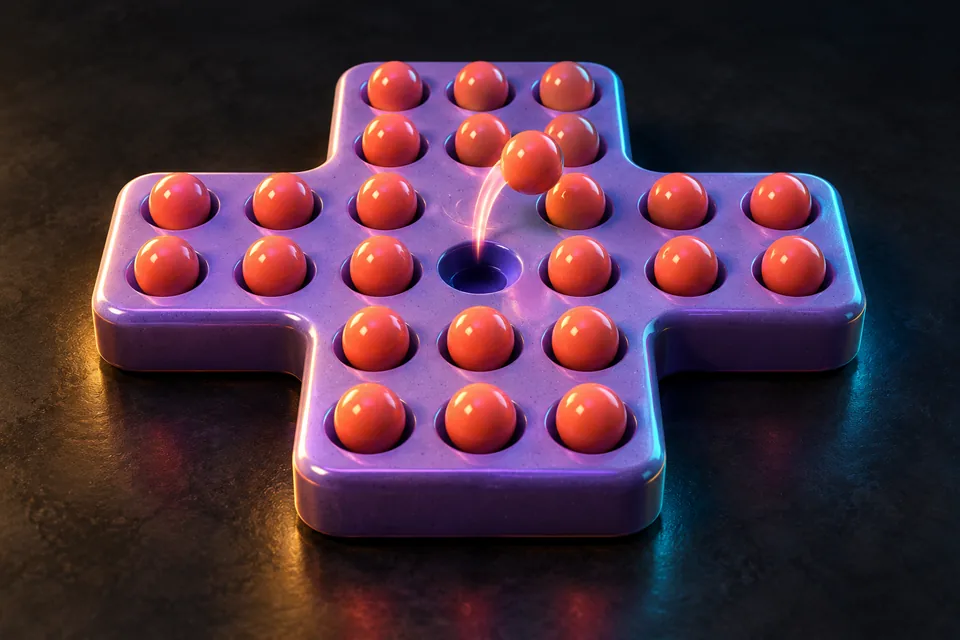
This guide covers ProjectGAMR's English cross as checked on October 27, 2026: thirty-three holes, thirty-two starting pegs and an empty center. Jumps are horizontal or vertical, never diagonal. Each accepted jump removes exactly one peg. The browser game accepts one remaining peg anywhere; CSPLib's classic central problem specifically requires the final peg at the center.
Read the board before choosing a jump
For the examples, label columns A through G from left to right and rows 1 through 7 from top to bottom. The center is D4. Only columns C, D and E exist in rows 1, 2, 6 and 7; rows 3, 4 and 5 contain all seven columns. A blank corner of the surrounding square is not an available hole.
A jump names its source and destination. D2 to D4 crosses D3: source and middle must contain pegs, while D4 must be empty. A diagonal-looking route does not become legal because its endpoints are nearby. Before committing, identify the exact middle hole and the landing hole.
Check a short opening without mistaking it for a solution
From New game, jump D2 to D4 over D3. The center becomes occupied, D2 and D3 become empty, and thirty-one pegs remain. Next jump B3 to D3 over C3. Now thirty pegs remain, with a peg back on D3. Both moves are legal on the actual starting board.
This two-jump opening is an exercise in tracking vacancies, not a promised winning continuation. Notice how the first jump creates a landing place for the second. Count accepted jumps rather than clicks: selecting a peg does not remove it, and an invalid destination does not reduce the peg count.
Work backward through a three-peg endgame
On paper, compose a separate position with pegs only at C4, D4 and F4; every other existing hole is empty. Jump C4 to E4 over D4. Two pegs remain at E4 and F4. Then jump F4 to D4 over E4. The final peg is at D4 after exactly two jumps.
Read the same exercise backward as a planning question. To finish at D4 using a peg from F4, the preceding position needs pegs at E4 and F4 and a vacancy at D4. The first jump supplies precisely that arrangement. This is a miniature endgame to reason about, not an arrangement that New game loads or proof that every earlier position can reach it.
Spot when a low peg count hides a dead end
Compare another paper position containing only A4, C4 and E4. All three pegs are separated by empty holes. None has an adjacent peg to jump, so the position has no legal continuation despite having the same peg count as the solvable example. Three remaining pegs are not automatically better arranged than four.
Inspect the support for a proposed final jump before removing a useful neighbor. Simply keeping everything near the center is not a complete rule: a central peg can still lack a partner or an empty landing hole. A proposed ending remains a hypothesis until the preceding jumps actually connect to it.
Use the controls to keep your reasoning aligned
In ProjectGAMR, select the source peg, then the empty destination. New game restores the same center-empty cross; this interface does not provide an Undo button or an editor for the paper examples. If you lose track, restart and replay the short opening instead of assuming the miniature arrangement is still relevant.
From thirty-two pegs, a successful one-peg finish requires thirty-one accepted jumps because each removes one peg. That count checks the arithmetic, not the quality of a route. Before your next jump, name its vacancy, its supporting neighbor and the following jump you hope to make. Revise the plan when the board no longer supplies them.
Keep exploring
Sources & further reading
- Simon Tatham's Portable Puzzle Collection: Pegs rules and board variants ↗
- CSPLib prob037: English peg solitaire and the classic central goal ↗
Have a correction? Tell our editorial team.