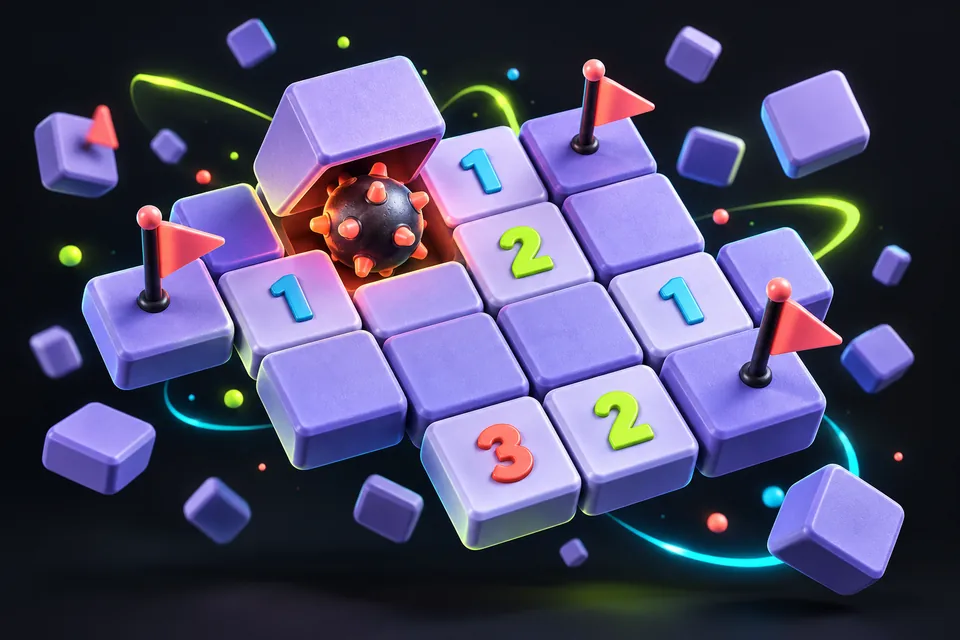
Minesweeper Logic: What the Numbers Tell You
Learn safe-cell deductions, mine deductions and a fully specified 1–2–1 example. Know when Minesweeper gives proof and when a move remains uncertain.
A number counts neighbors, including diagonals
On a standard square Minesweeper board, a revealed number tells you how many of the surrounding cells contain mines. A middle cell has up to eight neighbors, including diagonals. Edge and corner cells have fewer. Your goal is to reveal every safe cell without opening a mine.
A flag records your belief about a covered cell. It does not prove there is a mine there. The developer documentation linked below provides a clear rules reference, but its special no-guess generation options do not automatically apply to other implementations. Use the rules and guarantees stated by the particular game you are playing.
Subtract only confirmed mines
Suppose a revealed 3 touches one proven mine and four other covered cells. The remaining four contain exactly two mines. You have narrowed the problem, but have not identified which two cells are dangerous. Replacing uncertainty with four flags would introduce an error.
Two simple deductions do identify cells. If a clue has already accounted for all its mines, its other covered neighbors are safe. If the number of unaccounted mines equals the number of remaining covered neighbors, all those neighbors are mines. Count the neighbors carefully before applying either rule, especially around a corner where diagonal cells are easy to miss.
Work through a precise 1–2–1 pattern
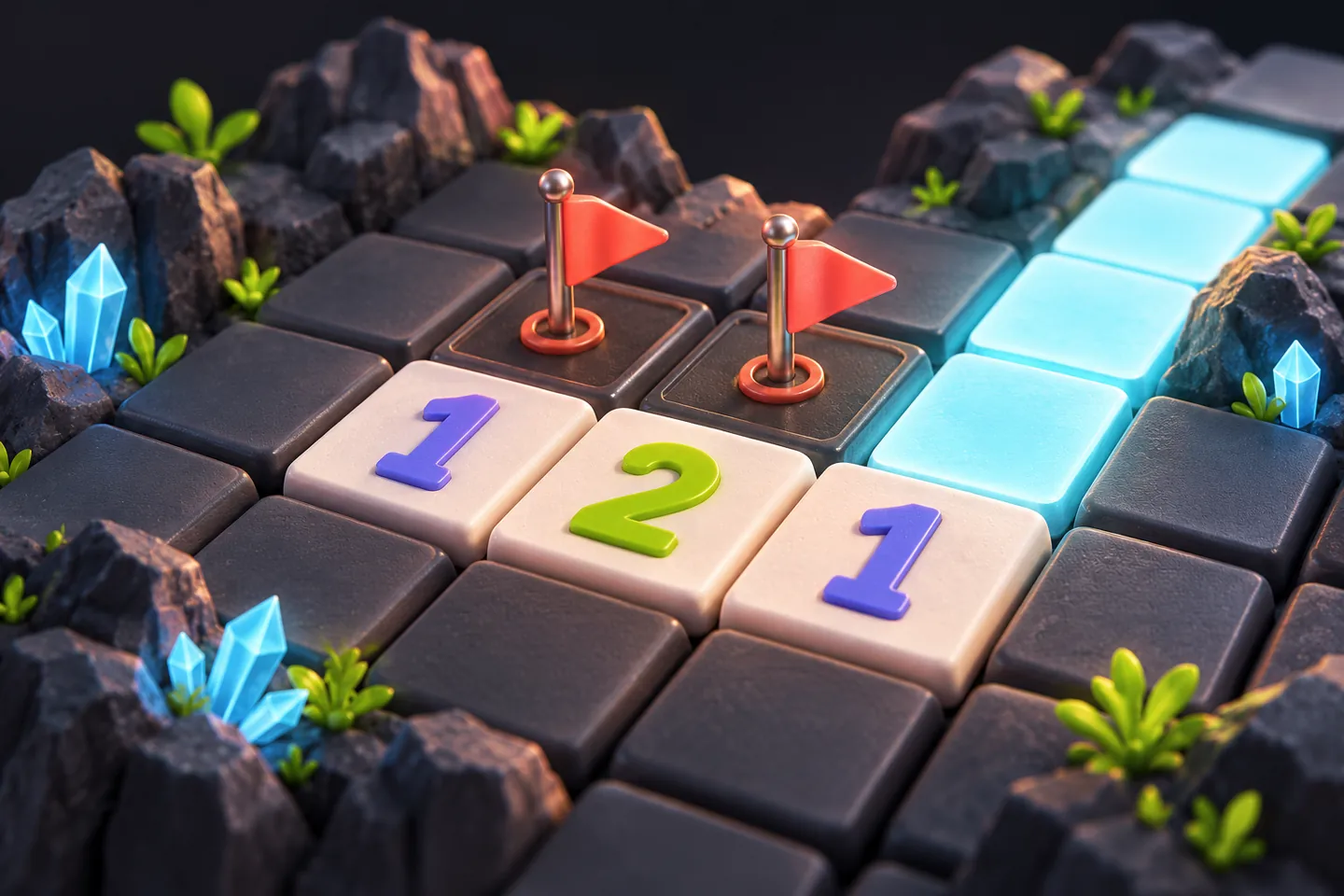
Consider three covered cells A, B and C in one row. Directly below them are revealed clues 1, 2 and 1. Assume every other neighbor of those clues has already been revealed safe. The left clue sees A and B, the middle sees A, B and C, and the right sees B and C.
The constraints are A+B=1, A+B+C=2 and B+C=1, where a mine is one and a safe cell is zero. Subtract the first equation from the middle: C=1. Then B=0 from the right equation, leaving A=1. A and C are mines; B is safe.
Why the surrounding cells matter
The same visible 1–2–1 digits do not justify that answer if other unknown neighbors remain. An extra covered cell beside the middle clue changes its equation. The shape is a shortcut for a specific set of constraints, not a magic pattern that works in every orientation or context.
The more general idea is subset reasoning. If one clue’s unresolved neighbors are exactly A and B with one mine, while another sees A, B and C with one mine, C must be safe. Their shared pair already supplies the second clue’s entire mine count. Compare actual neighbor sets before making the deduction.
Recognize genuine uncertainty
Sometimes two or more mine arrangements satisfy every revealed clue. If A+B=1 is the only information about two cells, either could contain the mine. No amount of confidence makes one logically safe. Additional board information, including a trustworthy total remaining mine count, may still resolve the choice.
If a guess remains unavoidable, label it as a risk rather than pretending you found a proof. A cell in a constrained region is not automatically safer than an unexplored cell. Comparing probabilities requires counting consistent mine arrangements and considering the rest of the board. “This square looks less suspicious” is not that calculation.
Practice for accuracy before speed
Pick one boundary between revealed and covered cells. For each clue, note its remaining mine count and its unresolved neighbors. Make one proven deduction, update nearby clues, then repeat. This gives each flag a reason and reduces the chance that one mistaken assumption spreads across the whole board.
Be cautious with any shortcut that opens several neighbors at once. If it relies on flags, a misplaced flag can make that action unsafe. After a loss, inspect whether the move was a deliberate risk, a counting error or an unsupported pattern match. Those are different mistakes and call for different improvements.
Sources & further reading
Have a correction? Tell our editorial team.