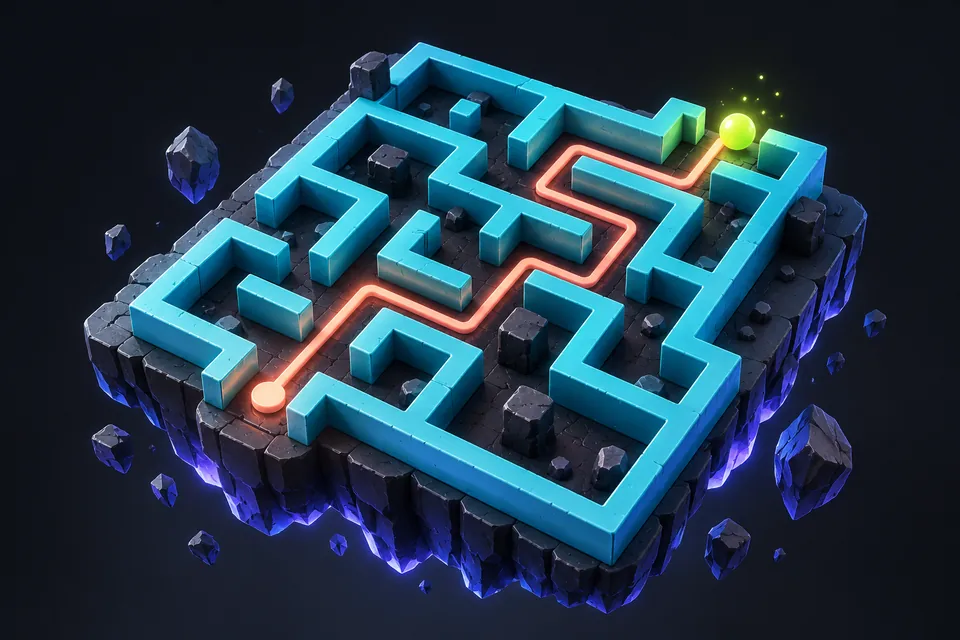
Maze Solving Strategy: Backtrack to the Last Junction
Use this maze solving strategy to mark dead ends and return to the last junction with an untried corridor. Follow a checked route in Maze Escape.

Identify the entrances to each branch
This maze solving strategy gives you a place to resume after testing a corridor. The examples use ProjectGAMR’s Maze Escape as tested on November 14, 2026. Use an arrow key or select an open neighbor to move by one square.
When you reach a maze junction, note the direction you arrived from and the other open directions. Start exploring one of those corridors and keep the others on a short list. At a bend with only one way forward, continue until you reach another choice, the exit, or a dead end.
Keep an address for your last choice
Count the visible rows and columns from one at the upper-left corner of the grid. On a checked board, the player starts at row 2, column 2. Move right twice, down four times and left twice to reach row 6, column 2 in eight steps.
At that cell, the corridor to the right is the way you arrived. The open squares above and below offer two branches. You might write down “row 6, column 2, up and down” before picking one. This gives you an address to return to.
Retrace the dead end one square at a time
Try the upper branch in the checked board. Two steps up bring you to row 4, column 2. The only open neighbor there is the square you just came from. Mark the upper branch as explored, then move down twice to return to row 6, column 2.
Both parts of that detour count. The counter reaches ten at the dead end and twelve back at the junction. A wall click or a click on the distant goal leaves your position and the counter where they were.
Resume at the nearest junction with an untried corridor
Back at the junction, try the untried corridor. On this board, four steps down reach row 10, column 2, where the corridor turns right. The entire route from that junction to the exit takes twenty-eight steps.
If you pass another junction and reach a dead end beyond it, check that newer junction first on your way back. Keep returning along your route until a junction has a branch left to explore. Cross out a branch once you have exhausted it.
Compare the route with the distance you walked
The verified run that tested the upper branch reached the exit in forty steps. Going directly via the lower branch on the same board took thirty-six. The four-step difference came from walking two squares into the upper branch and two squares back.
MIT's introductory algorithms notes describe this order of exploration as depth-first search. You follow a branch and return toward the latest untried neighbor when needed. The step count in Maze Escape includes every move you make during that search.
Rebuild your notes for a fresh board
Choose New game to generate another maze. The checked turns and coordinates belong to one board, so read the new corridors before moving. At each choice, note the directions that still lead somewhere you have yet to explore.
On a wide screen you may be able to trace short dead ends visually before entering them. When a branch is hard to follow, use backtracking and the saved junction address. Resume where another direction is available.
Keep exploring
Sources & further reading
- ProjectGAMR Maze Escape board and rules ↗
- ProjectGAMR published Maze Escape implementation ↗
- MIT OpenCourseWare 6.006 Lecture 14, Depth-First Search ↗
Have a correction? Tell our editorial team.