Make 24 Strategy: Build Products and Useful Fractions
Use this Make 24 strategy to build useful products and fractions. Checked examples explain all-four-number rules, parentheses and common rejected answers.

Keep the number rule beside the target
A useful Make 24 strategy keeps two questions visible: does the expression equal 24, and does it use the dealt numbers correctly? In ProjectGAMR's version, use each of the four displayed numbers exactly once with addition, subtraction, multiplication, division and parentheses. Joining digits, adding another number or using powers is outside this rule set.
The local generator uses numbers from 1 through 9 and checks that a solution exists. Repeated values are possible, so a deal containing two 3s requires two occurrences of 3 in your expression. This guide covers that implementation as checked on October 23, 2026, rather than importing the timer, scoring or card distribution of another 24 game.
Work backward from a useful final operation
Begin with a possible finishing shape: 6 times 4, 8 times 3 or 12 times 2. Ask whether the four numbers can be divided into groups that build those values. This is a search aid, not a promise that a product of two whole-number groups will solve every deal.
For the illustrative deal 1, 2, 3, 4, build 4 from 1 plus 3 and build 6 from 2 plus 4. The complete expression is (1+3)*(2+4). Its two groups produce 4 and 6, and their product is 24. Mark each number as used when assigning it to a group so that a promising partial calculation does not spend the same entry twice.
Let a fraction be a useful intermediate result
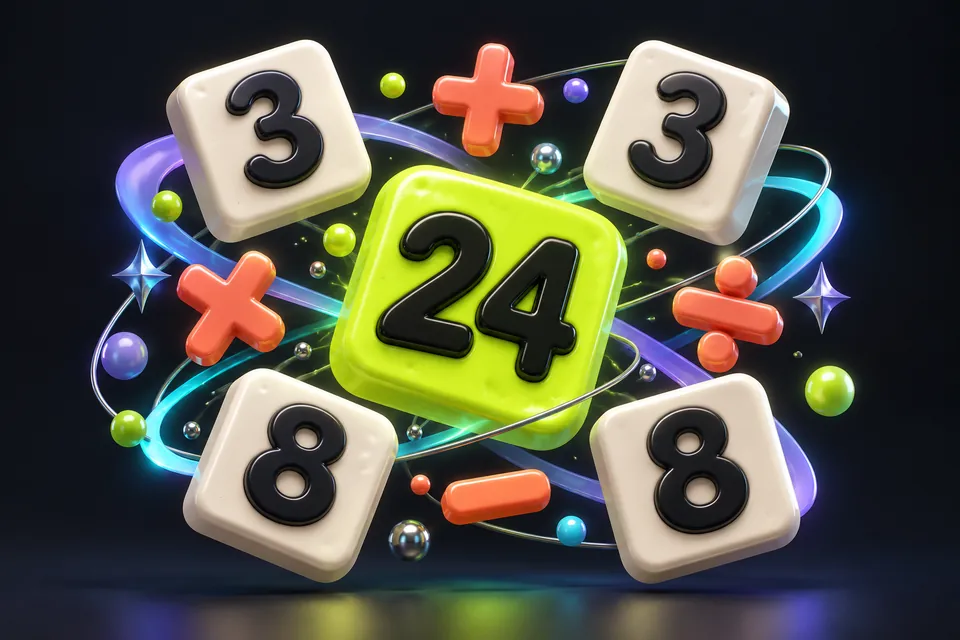
The deal 3, 3, 8, 8 shows why whole-number intermediates can be too restrictive. A finishing division of 8 by one-third would make 24. Reserve one 8 for that numerator, then ask whether the remaining 3, 3 and 8 can produce the required denominator.
They can: 3 minus 8 divided by 3 equals one-third, because 3 is nine-thirds. The full expression is 8/(3-8/3). Every dealt number appears once, counting both copies of each repeated value. The one-third is constructed from the available numbers; it is not an extra number you are allowed to type independently.
Check value and number use independently
On that same 3, 3, 8, 8 deal, 8*3 reaches 24 but leaves another 3 and 8 unused. It therefore fails the number-use rule. By contrast, (8-3)*(8-3) uses all four entries correctly but makes 25. Passing one check does not compensate for failing the other.
When an attempt is rejected, identify which check failed before changing the calculation. A number-use problem calls for rebuilding the expression from the four entries. A value problem calls for checking the operations and grouping. Keeping those diagnoses separate makes the next attempt more deliberate than replacing operators at random.
Write the grouping you intend the game to evaluate
Parentheses determine which quantities belong together. Removing the outer grouping from the fraction example gives 8/3-8/3, which equals zero. The original denominator must remain the entire expression 3-8/3. Do not confuse a compact string of symbols with the same mathematical structure.
In ProjectGAMR, type * for multiplication and / for division, then choose Check expression or press Enter in the expression field. Division by zero is rejected. The examples here are checked expressions for stated deals, not claims that New game will produce those numbers on demand. There is no custom-deal control in this interface.
Use a revealed solution as a pattern to explain
Show a solution reveals one valid expression for the current deal. Before selecting it, write down the finishing operation you tried and which numbers remained. Afterward, identify the intermediate result you missed: perhaps a small denominator, a useful sum or a subtraction that gets a factor into place.
That comparison is a proposed practice habit, not evidence of a measured improvement. New game generates another checked deal, while the current one remains useful for explaining why an expression works. The aim of this method is a calculation you can verify step by step, with all four numbers accounted for.
Keep exploring
Sources & further reading
- University of Cambridge NRICH: The 24 Game and order-of-operations activity ↗
- University of Cambridge NRICH: Make 24 rules and no joining digits ↗
Have a correction? Tell our editorial team.