Go for Beginners: Start on a Small Board
Start Go on a nine-by-nine board with liberties, captures and a worked score. Learn the site’s simple ko and area-scoring rules before your first game.
Start small and declare the rules
Go is played on intersections, not inside squares. For this site’s simplified local game, use a nine-by-nine board, alternate placing stones with Black first, and count area at the end. White receives 6.5 komi points to compensate for moving second. Two consecutive passes end the game.
The game forbids suicide and immediate recapture that repeats the previous board position, called simple ko. These choices are explicit because Go has several rule systems. The British Go Association references below explain the core ideas and rule differences. This small-board implementation is a learning format, not a claim to reproduce every tournament procedure.
Count liberties as empty neighboring points
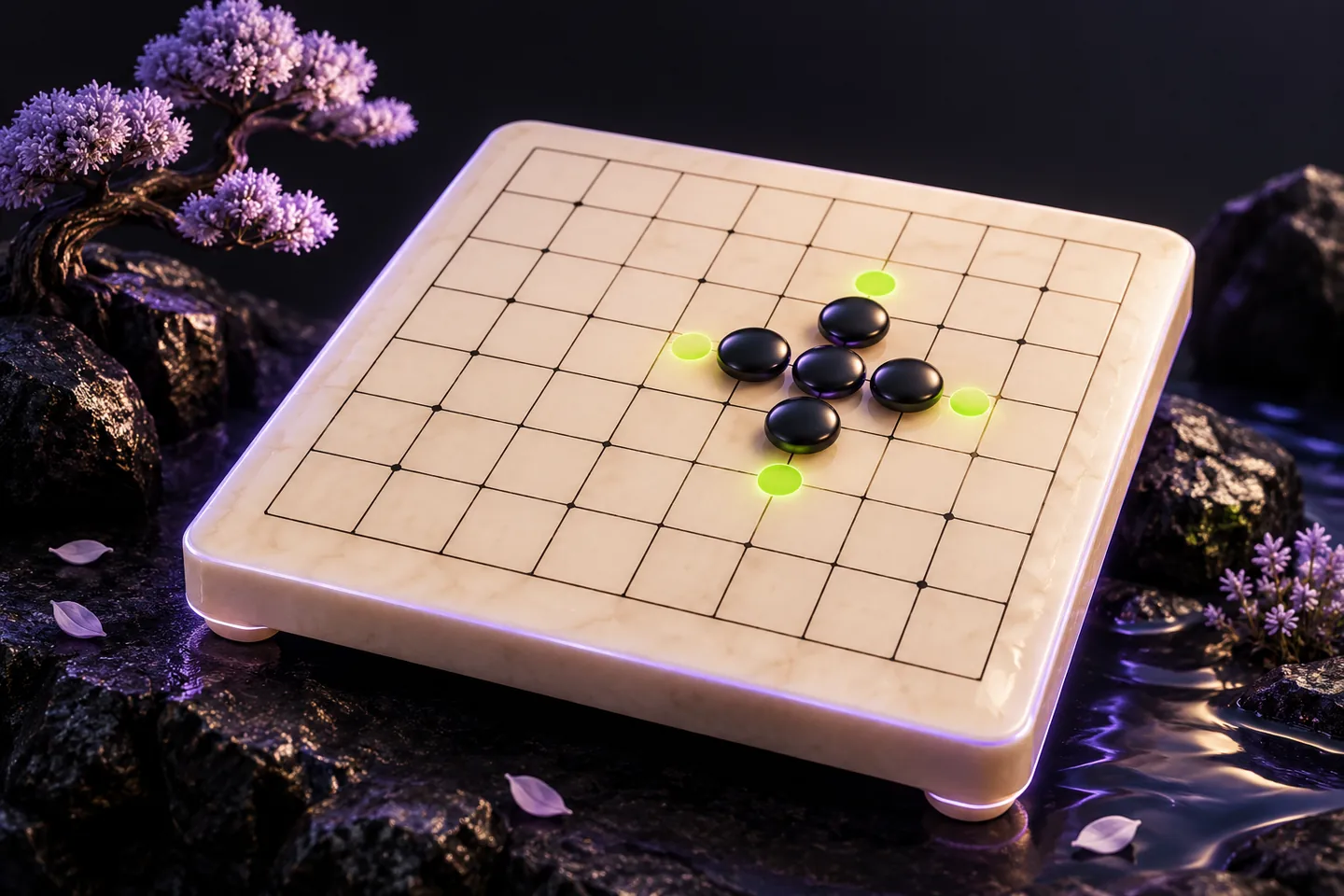
A stone’s liberties are empty intersections directly above, below, left and right. Diagonals do not count. Stones of the same color joined along those directions form a group and share its liberties. Count each empty point once even if it touches several stones of the group.
An isolated center stone normally has four liberties; an isolated corner stone has two. Adding a connected stone does not simply add four more, because occupied and shared points must be removed from the count. Before playing near a fight, trace the entire connected group, then list the empty points touching it.
See a capture happen
Consider a black stone on B2 with white stones on A2, B1 and C2, while B3 is empty. Black’s remaining liberty is B3. If White legally plays B3, the black stone has no liberties and is removed. That vacated B2 point can then provide liberties to neighboring stones.
The edge of the board acts as a boundary, not an extra liberty. A group with one liberty is in atari: it can be captured on the next move unless something changes. When your group is threatened, consider extending, connecting to another group, or capturing the attacking stones. Not every threatened group is worth saving.
Avoid suicide and recognize ko
A placement is forbidden as suicide if, after any enemy captures are removed, its own group has no liberty. Capturing can make an apparently surrounded placement legal because removing the enemy group creates empty neighboring points. Evaluate the board after the capture, rather than judging only the occupied shape before it.
Simple ko prevents taking a single stone straight back when doing so immediately restores the previous board. You must first play elsewhere or pass before that immediate restriction changes. Longer repetition cycles require rules beyond simple ko; this guide does not claim that the simplified implementation resolves every rare tournament dispute.
Count an area score
Area scoring counts your stones still on the board plus empty intersections surrounded only by your color. Empty space shared by both sides is neutral. Captured stones are not added again as prisoner points under this method. Before passing, finish unsettled fights; this local format does not negotiate which disputed groups should be removed as dead.
For a worked nine-by-nine count, suppose Black has 15 stones and 20 empty territory points: 35. White has 14 stones and 19 territory points: 33, plus 6.5 komi gives 39.5. The remaining 13 intersections are neutral. White wins this example by 4.5 points.
Build a first-game plan
Try to make connected groups with room to expand instead of chasing every opposing stone. A group pressed against an edge has fewer escape directions. Before each placement, count the weakest nearby group’s liberties and ask whether your move improves them or creates an unnecessary new fight.
After the game, review one capture and one area boundary. Could a connection have kept a group alive? Was an empty region truly yours, or did an opponent still have a legal way to enter? Small boards make these questions manageable. Learn to finish and count a game clearly before worrying about elaborate opening patterns.
Sources & further reading
Have a correction? Tell our editorial team.