2048 Corner Strategy: Keep Space for Your Next Merge
Learn a practical 2048 corner strategy with worked merge examples, empty-space checks and a recovery plan when your preferred direction stops working.
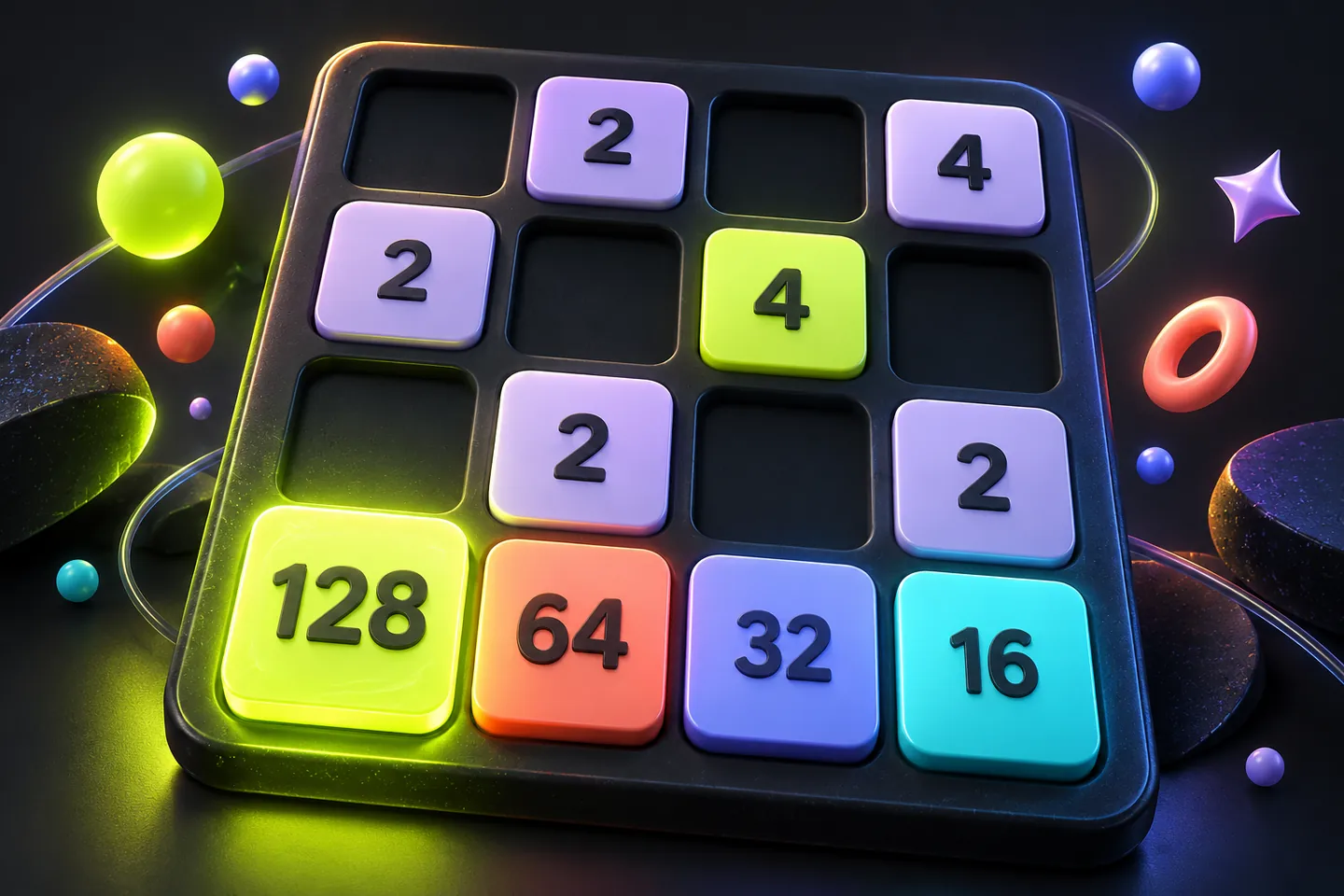
Give your largest tile a home
A useful 2048 corner strategy gives the board a stable shape: keep the largest tile near one chosen corner, arrange smaller values beside it, and protect space where new tiles can be handled. It is a planning aid, not a guaranteed winning sequence. Random arrivals can still force difficult decisions, and a move that saves one corner can damage the rest of the board.
This guide uses ProjectGAMR’s four-by-four version. Arrow keys or direction buttons slide the whole board; equal tiles can merge once per move. A move that changes nothing does not add a tile. Active boards reset on refresh here, so finish your experiment before closing the page.
Predict merges before the random tile appears
Write a row from left to right as [2, 2, 4, 0], where zero means empty. Sliding left gives [4, 4, 0, 0] before the new tile arrives, with four points added. The newly made four cannot immediately merge again in that same move. On a later left move, the two fours can become an eight if no intervening tile separates them.
Compare [4, 4, 4, 4]. A left move produces [8, 8, 0, 0], adding sixteen points, rather than making a sixteen immediately. These are composed row examples, not predictions of the complete next board: the successful move also creates a random tile in an empty square.
Build an ordered edge, then feed it
Suppose your chosen corner is bottom left. An illustrative bottom row is [128, 64, 32, 16]. Keeping that row reasonably ordered gives smaller tiles a route toward larger partners. Use the rows above to prepare a second sixteen before trying to feed the edge. If you scatter the small tiles between the large ones, assembling the next pair becomes harder.
Do not mistake an attractive row for a solved board. Read the columns too. A downward slide might preserve the large corner tile while filling every useful working square above it. Before committing, identify where the next matching pair could meet and which empty square keeps that route available.
Count space as well as points
A move can earn points and still leave an awkward position. With only one empty square, ask whether your next legal slide will open another square or merely shuffle the congestion. With several empty squares, you usually have more places to prepare pairs, although their arrangement matters as much as their number.
Try comparing two candidate directions on paper. For each, record the merges, remaining empty squares and the largest tile’s location before the random arrival. Then consider an inconvenient new tile rather than imagining only the most helpful one. Choose the position you can explain, instead of automatically selecting the highest immediate score.
Break your preferred pattern deliberately
Avoiding one direction can help maintain an edge, but an absolute ban can end a recoverable run. If left and down no longer change the board, inspect right and up. Compare the displacement they cause with the merge or escape they make possible. A temporary retreat can be preferable to having no legal move.
Before moving away from the corner, name a recovery objective: reunite a separated pair, reopen a column, or bring the largest tile back toward its edge. The original shape may no longer be recoverable. When that happens, build a coherent new arrangement rather than spending every move trying to recreate an obsolete one.
Practice one decision you can review
Start a fresh game and pause whenever the board becomes crowded. Write down two possible slides and your reason for preferring one. After the new tile appears, separate what you predicted correctly about movement from what was uncertain about its arrival. A bad random outcome does not automatically mean the decision was wrong.
For your next session, review the earliest move that split useful partners or removed your working space. That is a more specific lesson than simply deciding to play faster. Use the playable 2048 page below to try the examples; the related practice guide offers a way to record a small, repeatable learning goal.
Keep exploring
Sources & further reading
Have a correction? Tell our editorial team.